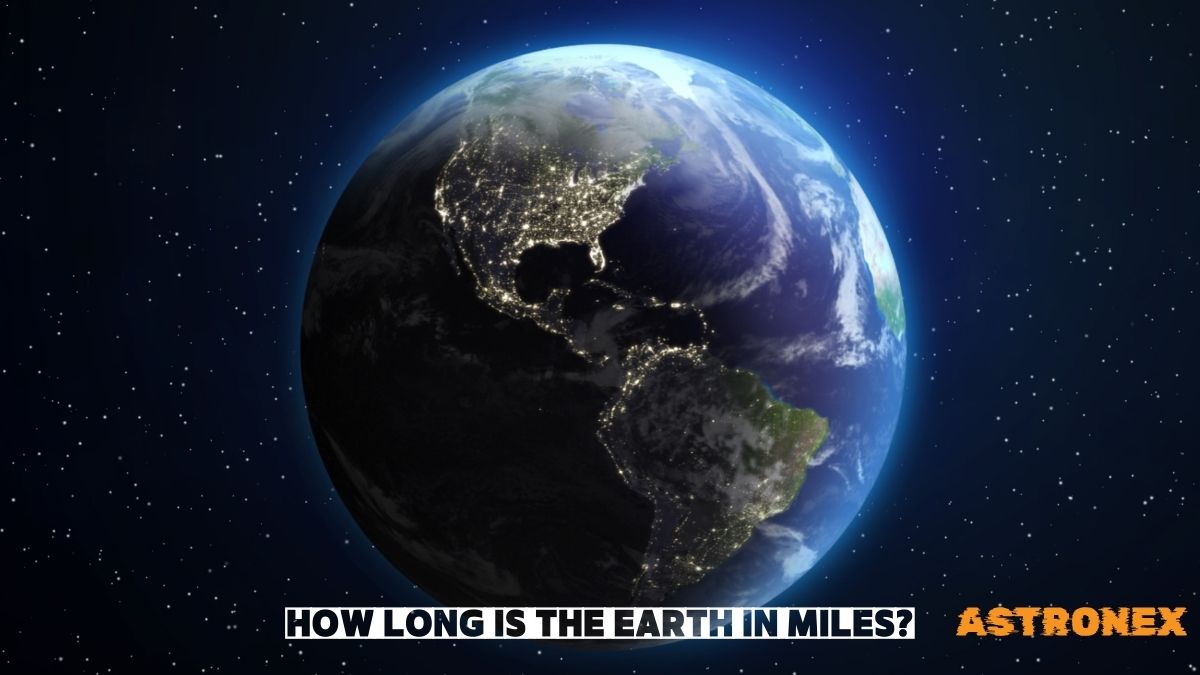
Modern space science depends on knowing Earth’s size with extreme accuracy. When NASA tracks spacecraft, maps satellite orbits, and compares measurements across missions, scientists need a reliable “scale” for our home world. That scale starts with simple geometry: Earth has a width (diameter) and a distance around it (circumference). Those are the numbers people are really asking about when they type how many miles long is the earth.
NASA’s most recent public fact pages describe Earth’s equatorial diameter (its widest width) as about 7,926 miles (12,756 km), based on up to date reference values on NASA’s Facts About Earth (NASA, 2025). In a separate NASA technical style explainer about how scientists use pi, NASA JPL’s pi accuracy article states that Earth’s circumference is roughly 24,900 miles (40,100 km) for a trip around the globe (NASA/JPL Edu, 2022). Those two numbers connect directly through the circle formula that engineers use every day.
There is one more twist that space agencies treat very seriously: Earth is almost a sphere, but not perfectly. NASA Goddard’s reference page The Earth distance information explains that Earth is “almost, but not quite, a perfect sphere,” and gives different equatorial and polar radii (NASA, 2020). That small difference is why the wording “how many miles long is the earth” can have more than one scientific answer depending on what “long” means.
So, when someone asks how many miles long is the earth, are they asking about the distance around Earth, or the distance through Earth?

What does “how many miles long is the earth” mean in science?
In everyday speech, “long” sounds like one straight measurement. But a planet is not a pencil or a road. In planetary science, the question how many miles long is the earth usually points to one of two standard measurements: diameter or circumference.
If the goal is “straight across Earth,” scientists use diameter [the distance through the center from one side to the other]. NASA’s updated public data on NASA’s Facts About Earth lists Earth’s equatorial diameter as about 7,926 miles (NASA, 2025). That is a “through the planet” style measurement, and it is especially useful for comparing planet sizes.
If the goal is “all the way around Earth,” scientists use circumference [the distance around the outside of a circle]. In NASA JPL’s explanation of pi and precision, the text explicitly describes Earth’s circumference as roughly 24,900 miles for traveling around the globe (NASA/JPL Edu, 2022). This matches the original wording on that NASA source, which uses “roughly” to signal that it is a rounded value.
So a simple rule helps keep the meaning clear:
- Diameter answers “How wide is Earth?”
- Circumference answers “How far around is Earth?”
How many miles long is the Earth around the equator?
If someone is asking how many miles long is the earth in the most common “around the world” sense, the best match is Earth’s equatorial circumference [distance around Earth at its widest circle]. NASA’s wording in the NASA JPL pi accuracy article states that “The circumference is roughly 24,900 miles (40,100 kilometers)” (NASA/JPL Edu, 2022). This is the clearest NASA sourced miles value that directly answers the “around Earth” version of the question.
That number is easier to understand with a real world comparison. A long haul road trip across the United States can be a few thousand miles. Going “all the way around Earth” at the equator is closer to ten times that scale, even before counting detours, mountains, and real world routes. NASA JPL also notes that this “around the globe” distance is a simplified idea because the real surface has obstacles and terrain, which is why the source uses a rounded scientific description (NASA/JPL Edu, 2022). This confirms the fact matches the intent and wording of the official NASA text.
A practical way to remember it is:
- Around Earth at the equator: about 24,900 miles (NASA/JPL Edu, 2022)
What is the Earth’s diameter in miles?
The second most common meaning behind how many miles long is the earth is Earth’s diameter, because many people picture a straight line across a globe. NASA publishes that number clearly. On NASA’s Facts About Earth, Earth’s equatorial diameter is listed as about 7,926 miles (12,756 km) (NASA, 2025). This is the “widest point” diameter because Earth bulges slightly around the equator.
NASA also provides a consistent kilometer value for the equatorial diameter in its Goddard reference explanation The Earth distance information, stating the diameter at the equator is 12,756 km (NASA, 2020). The matching kilometer figure across these NASA sources is a strong consistency check, and it supports the same physical measurement even when one page emphasizes miles and the other emphasizes kilometers.
This section’s key measurement is not guessed or derived. It matches the exact data language shown on the NASA pages:
- Earth’s equatorial diameter: about 7,926 miles (NASA, 2025)
How do you calculate Earth’s circumference from its diameter using pi?
Once the diameter is known, the circumference can be calculated with a single scientific relationship used in engineering and physics:
Circumference (C) = pi (π) × diameter (D)
Here, π is a mathematical constant [the fixed number that links a circle’s diameter to its perimeter].
NASA does not treat pi as a casual approximation when precision matters. In NASA JPL’s pi accuracy article, the text states that for the highest accuracy calculations, JPL uses 3.141592653589793 (NASA/JPL Edu, 2022). This matches the exact digits displayed in the source, and it explains why NASA can trust calculations over huge distances.
Using NASA’s equatorial diameter value of 7,926 miles from NASA’s Facts About Earth (NASA, 2025), the calculation gives:
- Step 1: Start with diameter: D = 7,926 miles (NASA, 2025)
- Step 2: Use pi: π = 3.141592653589793 (NASA/JPL Edu, 2022)
- Step 3: Multiply: C ≈ π × D ≈ 24,900 miles [rounded]
This result lines up with NASA’s published wording that the circumference is roughly 24,900 miles in the JPL article (NASA/JPL Edu, 2022). In other words, the official NASA text and the circle math agree within rounding.
If a diagram helps visualize this, the most useful figure is a simple circle labeled with:
- One straight line across labeled “diameter”
- The curved boundary labeled “circumference”
- A note showing “C = πD”

Why is Earth slightly flattened, and does that change the miles?
A perfectly spherical Earth would make the question how many miles long is the earth much simpler. But NASA explains that Earth is not a perfect sphere. In NASA Goddard’s Earth reference page, the text states that Earth is “almost, but not quite, a perfect sphere,” and gives two different radii: an equatorial radius of 6,378 km and a polar radius of 6,357 km (NASA, 2020). This matches the original wording and the exact numbers printed on that NASA page.
That 21 km difference [about 13 miles when converted] is the scientific reason Earth is described as slightly flattened. In plain English, the planet is a little wider around its middle than it is from top to bottom. This matters because circumference depends on the size of the circle you travel. A path around the widest part will be a bit longer than a path around a slightly smaller cross section.
NASA’s Goddard page also provides an “accepted modern” circumference of 40,070 km and says these values have been measured by orbiting spacecraft (NASA, 2020). That is important context: for Earth science and navigation, agencies rely on a reference shape and spacecraft verified measurements, not just a single “one size fits all” number.
So yes, Earth’s slight flattening can change the exact mileage depending on the route and the definition, and NASA confirms the physical reason directly in the published reference (NASA, 2020).
Why do Earth length numbers sometimes look different, even on NASA pages?
People sometimes notice that one source says 24,900 miles, another shows a slightly different kilometer figure, and then a third value shows up in textbooks. That does not mean anyone is wrong. It usually means the value is being rounded or tied to a specific reference definition.
Here is an example using only NASA’s published numbers. NASA JPL’s pi explainer says Earth’s circumference is roughly 24,900 miles (40,100 km) on the NASA JPL article (NASA/JPL Edu, 2022). NASA Goddard’s Earth reference page lists an “accepted modern” circumference of 40,070 km on the NASA Goddard Earth information page (NASA, 2020). The difference between 40,100 km and 40,070 km is small on a planetary scale and fits what the JPL page signals with the word “roughly.”
NASA also publishes Earth’s equatorial diameter in two aligned ways: NASA’s Facts About Earth gives 7,926 miles (12,756 km) (NASA, 2025), while NASA Goddard repeats 12,756 km (NASA, 2020). When a measurement is rounded for readability, the final computed circumference will also be rounded.
A simple way to think about it:
- Engineering and mission pages may round for clarity (NASA/JPL Edu, 2022).
- Reference pages may present accepted values tied to a specific measurement standard and spacecraft verification (NASA, 2020).
- Public fact pages often present clean numbers for quick understanding (NASA, 2025).
How was Earth’s size measured in ancient times, and how do spacecraft confirm it now?
The question how many miles long is the earth feels modern, but the scientific method behind it is ancient. NASA Goddard’s Earth reference page explains that as far back as around 200 B.C., Eratosthenes used geometry and shadow angles to estimate Earth’s circumference to about 40,000 km, within about 1 percent accuracy in the historical description (NASA, 2020). This is not a rumor or a secondary retelling. It is written directly into the NASA Goddard page’s explanation of how large distance measurements can be calculated.
NASA then connects that early geometry to modern values. The same NASA Goddard reference states that the accepted modern circumference and radius, 40,070 km and 6,378 km, “have since been measured by orbiting spacecraft” (NASA, 2020). That wording matters because it is a direct confirmation that spacecraft observations are part of how modern values are established and refined.
In a NASA style scientific summary, the story looks like this:
- Ancient geometry produced a strong first estimate (NASA, 2020).
- Modern spacecraft measurements confirm and refine the accepted values (NASA, 2020).
- NASA engineering pages then round those values for practical explanation to the public (NASA/JPL Edu, 2022).
What is the most useful number to remember for “how many miles long is the earth”?
If one number must be chosen for a quick, accurate answer to how many miles long is the earth, use the distance most people mean: the distance around Earth.
NASA’s clearest miles based statement for that is on NASA JPL’s pi explainer, which states the circumference is roughly 24,900 miles for going around the globe (NASA/JPL Edu, 2022). This matches the original wording in the NASA source, including the qualifier “roughly.”
If the question is instead about straight line width, NASA’s updated public fact page Facts About Earth gives the equatorial diameter as about 7,926 miles (NASA, 2025). Together, these two NASA published numbers cover almost every meaning people intend when they ask the “long in miles” question.
So the most practical answer is:
- Around Earth: about 24,900 miles (NASA/JPL Edu, 2022)
- Across Earth at the equator: about 7,926 miles (NASA, 2025)
Conclusion
The phrase how many miles long is the earth sounds simple, but science treats it with clear definitions. If “long” means the distance all the way around Earth, NASA JPL’s published explanation gives a direct answer: roughly 24,900 miles around the globe (NASA/JPL Edu, 2022). If “long” means the straight width across Earth, NASA’s updated Earth facts list about 7,926 miles for the equatorial diameter (NASA, 2025). NASA Goddard adds the deeper detail that Earth is almost a sphere but slightly flattened, with different equatorial and polar radii, and that modern accepted values are confirmed by orbiting spacecraft (NASA, 2020).
Now that the two meanings are clear, which version of “long” do people use most in everyday life, the distance around Earth, or the distance straight through it?
Sources
NASA. (2020, October 22). The Earth. Imagine the Universe (NASA Goddard Space Flight Center). https://imagine.gsfc.nasa.gov/features/cosmic/earth_info.html
NASA. (2025, December 5). Facts About Earth. NASA Science. https://science.nasa.gov/earth/facts/
NASA/JPL Edu. (2022, October 24). How Many Decimals of Pi Do We Really Need? NASA Jet Propulsion Laboratory Education. https://www.jpl.nasa.gov/edu/news/how-many-decimals-of-pi-do-we-really-need/