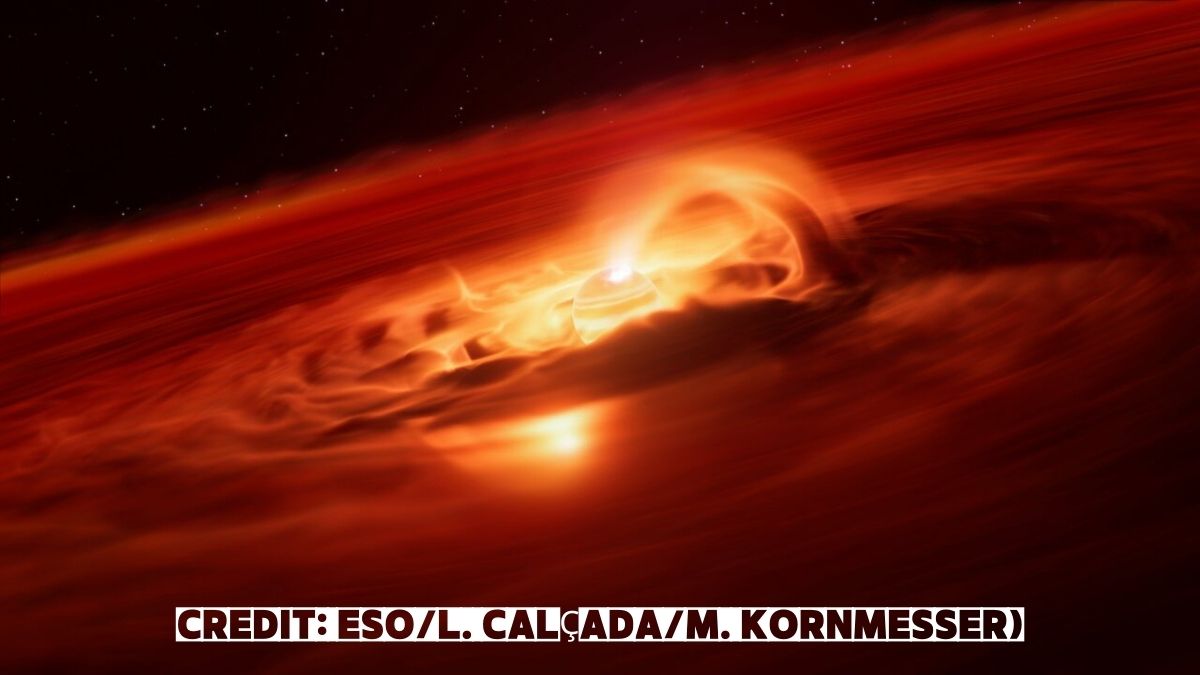
Recent observations have revealed a remarkable event in a distant free-floating planetary-mass object known as Cha 1107-7626. Located approximately 620 light-years away in the Chamaeleon constellation, this young body, with a mass estimated at 5 to 10 times that of Jupiter, does not orbit any star. Instead, it drifts independently through space while actively pulling in gas and dust from a surrounding disk. In mid-2025, astronomers detected a significant increase in this accretion process, marking the strongest such episode ever recorded for an object in the planetary-mass range.
An international team, using the European Southern Observatory’s Very Large Telescope (VLT) and NASA’s James Webb Space Telescope (JWST), monitored the object over several months. They found that its accretion rate surged dramatically between April-May and June-August 2025. This burst-like activity resembles phenomena seen in young stars, providing new clues about how isolated planetary-mass objects form and evolve. As detailed in the European Southern Observatory’s announcement of the discovery, the process involves material from the disk falling onto the object at accelerated rates (Almendros-Abad et al., 2025).
How do such isolated worlds continue to grow without a host star’s influence?
What Is a Rogue Planet?
Rogue planets, also called free-floating planetary-mass objects, are worlds that wander through space without being bound to any star. These objects can form directly from collapsing gas clouds, similar to stars, or be ejected from young planetary systems due to gravitational interactions. Cha 1107-7626 falls into this category, with a mass well below the 13 Jupiter-mass threshold that separates planets from brown dwarfs (the failed stars that cannot sustain hydrogen fusion). Its youth, estimated at one to two million years, allows it to retain a circumplanetary disk of gas and dust, enabling ongoing accretion.
Unlike planets in our Solar System, which receive energy from the Sun, rogue planets rely on residual heat from formation and gravitational energy released during accretion. This makes them detectable in infrared light. For Cha 1107-7626, the disk provides the material for growth, even in isolation. Comparisons to Jupiter are useful: both are gas-rich giants, but this rogue object experiences more dynamic early evolution. Key characteristics include:
- Masses typically 1 to 13 times that of Jupiter.
- No orbital ties to a star, leading to independent trajectories.
- Potential for disks and accretion, blurring lines with low-mass stellar objects. The discovery highlights how these bodies can mimic stellar formation processes on smaller scales.
How Do Astronomers Detect Accretion in Rogue Planets?
Detecting accretion in faint, distant rogue planets requires sensitive instruments capable of capturing spectral signatures. For Cha 1107-7626, the team used the X-shooter spectrograph on ESO’s VLT to obtain optical and near-infrared spectra, alongside mid-infrared data from JWST’s MIRI and NIRSpec instruments. These observations spanned from April to August 2025, revealing a transition from a quiescent state to heightened activity.
Spectroscopy splits light into wavelengths, exposing emission lines from hot gas falling onto the surface. Hydrogen lines, such as Hα, broadened and intensified during the burst, indicating material infalling at high velocities. As reported in the peer-reviewed study published in The Astrophysical Journal Letters, the continuum brightened significantly, with optical fluxes rising 3 to 6 times (Almendros-Abad et al., 2025). Archival data from 2016 showed similar elevated activity, suggesting recurrence.
To illustrate variability, consider a timeline plot: quiescence in early 2025, onset in late June, and peak through August. Bullet points on detection methods:
- Time-series spectroscopy to track line fluxes.
- Multi-wavelength coverage for continuum and molecular changes.
- Comparison with pre-burst baselines for quantifying increases. These techniques transform subtle signals into evidence of dramatic cosmic events.
What Is the Accretion Rate During This Burst?
The peak accretion rate for Cha 1107-7626 reached approximately 10^{-7} Jupiter masses per year, equivalent to about six billion tonnes per second. This represents a 6- to 8-fold increase over quiescent levels, making it the highest measured for any planetary-mass object. The rate derives from calibrated emission line luminosities, particularly hydrogen series, adjusted for distance and extinction.
For perspective, one Jupiter mass equals roughly 1.9 × 10^{27} kilograms, so the burst adds material comparable to a large mountain range every minute. The ESO press release accompanying the research emphasizes this as the strongest episode recorded, persisting for at least two months (Almendros-Abad et al., 2025). Uncertainties arise from model assumptions, but values align across multiple indicators.
A comparison table could help visualize:
- Quiescent rate: ~10^{-8} Jupiter masses/year (0.75-1 billion tonnes/second).
- Burst peak: 10^{-7} Jupiter masses/year (six billion tonnes/second).
- Duration observed: At least two months, potentially longer. This extreme intake drives brightening and chemical changes in the disk.
How Does Magnetospheric Accretion Operate Here?
Magnetospheric accretion occurs when strong magnetic fields disrupt the disk at a certain radius, channeling gas along field lines to polar regions. In Cha 1107-7626, spectral lines developed double peaks with redshifted absorption during the burst, hallmarks of this funneling process. Infall velocities, inferred from line widths, range from tens of kilometers per second.
Models suggest field strengths in the kilogauss range, though these are inferences rather than direct measurements. The mechanism, previously observed mainly in stars and brown dwarfs, now extends to planetary scales. Instabilities in the disk likely trigger bursts by releasing piled-up material. Bullet points on the process:
- Disk truncation by magnetic pressure.
- Gas lifted and accelerated along field lines.
- Shock heating upon impact, producing emission. A schematic diagram of funnel flows would clarify the geometry, showing hot spots at impact sites.
What Changes Happen in the Disk During Accretion Bursts?
Accretion bursts heat the inner disk, altering its chemistry and emission. For Cha 1107-7626, mid-infrared fluxes increased 10-20 percent, with new water vapor features appearing at 6.5-7 micrometers—absent in quiescence. Hydrocarbon lines shifted, while silicate features remained stable, indicating unchanged dust grains.
These changes reflect higher temperatures dissociating and reforming molecules. The burst’s energy input processes the disk material rapidly. As noted in the detailed analysis in The Astrophysical Journal Letters, such effects mirror stellar outbursts but occur here in a substellar object (Almendros-Abad et al., 2025). Bullet points on key alterations:
- Continuum rise in mid-infrared.
- Emergence of water vapor emission.
- Persistent silicate band ratio (~0.88). Spectral comparisons before and after would highlight these molecular evolutions.
What Does This Mean for Understanding Planet Formation?
This burst in Cha 1107-7626 classifies it as the first planetary-mass object showing EXor-type activity, episodic outbursts common in young stars. It suggests some rogue planets form via direct collapse, sharing pathways with low-mass stars. Strong magnetic fields and disk instabilities operate even at 5-10 Jupiter masses, challenging strict planet-star distinctions.
Recurring events, hinted by 2016 data, could contribute significantly to final mass. Future observations with upcoming telescopes may reveal more such bursts, refining formation models. The findings underscore dynamic early phases for isolated worlds.
The 2025 discovery of intense accretion in Cha 1107-7626 demonstrates that rogue planets can undergo star-like growth spurts, accreting matter at unprecedented rates. This bridges planetary and stellar evolution, offering fresh perspectives on isolated worlds. Might many rogue planets harbor hidden moons formed amid such turbulent disks?
Sources
Almendros-Abad, V., Scholz, A., Damian, B., Jayawardhana, R., Bayo, A., Flagg, L., Mužič, K., Natta, A., Pinilla, P., & Testi, L. (2025, October 2). Discovery of an accretion burst in a free-floating planetary-mass object. The Astrophysical Journal Letters, 992(1), L2. https://doi.org/10.3847/2041-8213/ae09a8
European Southern Observatory. (2025, October 2). Six billion tonnes a second: Rogue planet found growing at record rate. ESO. https://www.eso.org/public/news/eso2516/