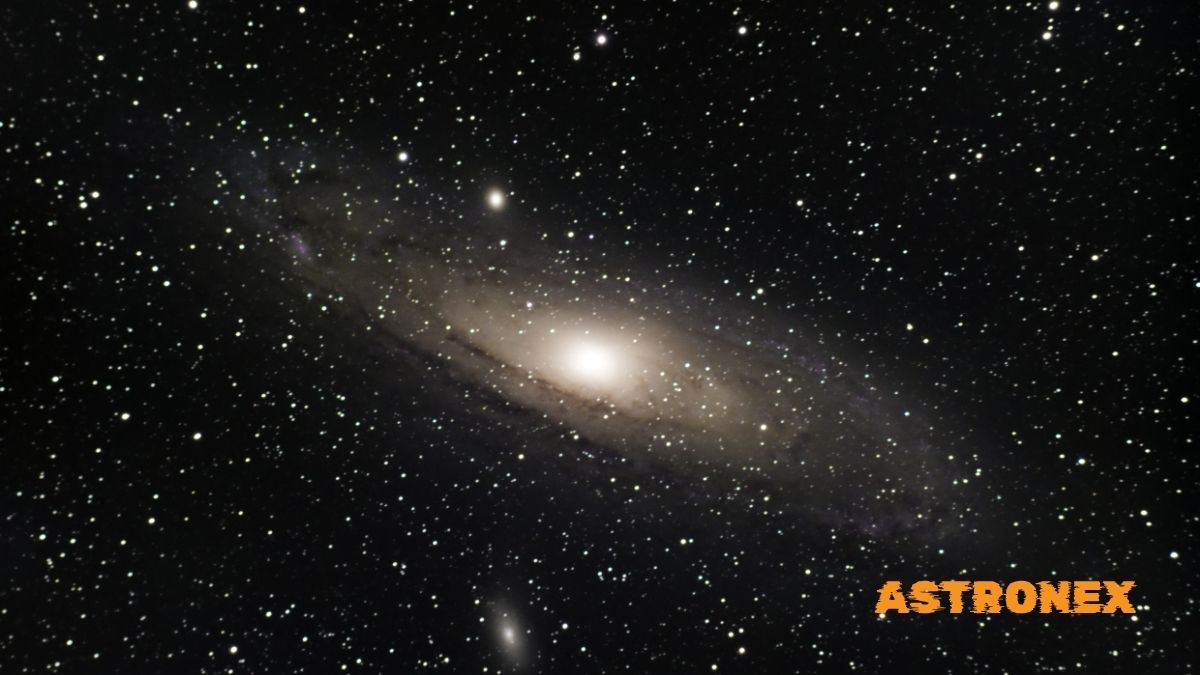
Supermassive black holes sit at the hearts of nearly every large galaxy, including our own Milky Way. These cosmic giants can weigh as much as billions of times the mass of our Sun, pulling in surrounding gas and stars with immense gravity. Recent observations from NASA’s James Webb Space Telescope (JWST) have spotted these behemoths in surprisingly young galaxies, just hundreds of millions of years after the Big Bang. For instance, in July 2025, astronomers announced the discovery of a possible million-solar-mass black hole forming right in the middle of colliding galaxies, a finding that challenges our understanding of how such massive objects assemble so early in cosmic history (NASA, 2025a).
The puzzle deepens when we look back to the universe’s infancy. Data from the European Space Agency’s Hubble Space Telescope, combined with JWST, reveal supermassive black holes active less than a billion years after the universe began, when it was only a few percent of its current age of 13.8 billion years. These early black holes power bright quasars, regions so luminous they outshine entire galaxies. Yet, building up to billions of solar masses in such a short time requires rapid growth mechanisms that scientists are still piecing together through advanced telescopes and computer models.
What secrets do these ancient giants hold about the birth of galaxies themselves?
What Are Supermassive Black Holes?
Supermassive black holes represent the most massive type of black hole known, with masses ranging from millions to tens of billions of times that of the Sun. Unlike smaller stellar-mass black holes, which form from the collapse of individual massive stars and typically weigh 5 to 100 solar masses, supermassive ones dominate the centers of galaxies. They are defined by their event horizon, the point of no return where gravity is so strong that not even light can escape, and its size scales with mass—for a billion-solar-mass black hole, this boundary stretches about 3 billion kilometers across, roughly 20 times the distance from the Earth to the Sun (in astronomical units, where 1 AU equals 150 million kilometers).
These black holes influence their host galaxies profoundly. As gas and dust spiral inward toward the black hole, they heat up and form an accretion disk, releasing tremendous energy as X-rays and other radiation. This process can heat surrounding gas to millions of degrees Kelvin (a measure of temperature where 1 million K is about 999,727 degrees Celsius), preventing it from cooling and forming new stars. According to NASA’s JWST infographic on black hole feedback, this regulatory role helps explain why massive galaxies like the Milky Way have a central bulge of older stars but fewer new ones forming today.
To visualize their scale, consider Sagittarius A*, the supermassive black hole at our galaxy’s core: it masses 4 million solar masses but appears quiet now, accreting gas slowly at rates equivalent to one Earth mass per year. In contrast, active ones like the one in galaxy M87, imaged by the Event Horizon Telescope in 2019, span a shadow 38 billion kilometers wide—larger than our solar system’s orbit of Neptune. Fun fact: If you replaced the Sun with a supermassive black hole of similar mass to Sagittarius A*, Earth’s orbit would remain unchanged, but the night sky would look very different without stellar light.
- Key characteristics: Event horizon radius scales as 3 km per solar mass (Schwarzschild radius formula: R_s = 2GM/c², where G is the gravitational constant, M is mass, and c is light speed at 300,000 km/s).
- Detection methods: Gravitational waves from mergers (via LIGO/Virgo), X-ray emissions from accretion (Chandra Observatory), and radio jets (Very Large Array).
- Distribution: One per large galaxy, with densities around 10^8 to 10^10 solar masses per cubic megaparsec in the local universe.
These objects are not just destructive; they shape cosmic evolution. Peer-reviewed studies, such as those in Astronomy & Astrophysics, confirm that early supermassive black holes grew alongside their host galaxies, with black hole mass correlating tightly to galactic bulge mass—about 0.2% on average (Andika et al., 2024).

How Do Supermassive Black Holes Grow?
Supermassive black holes primarily grow by accreting matter—gas, dust, and sometimes entire stars—from their surroundings, converting a fraction of this mass into energy via Einstein’s E=mc² (where only about 10-40% of infalling mass becomes radiation, the rest adds to the black hole). The accretion rate is often limited by the Eddington limit, a balance where radiation pressure pushes back against gravity; for a 10^9 solar-mass black hole, this caps growth at roughly 0.2 solar masses per year (calculated as L_Edd = 1.3 × 10^38 (M/M_sun) erg/s, with efficiency η ≈ 0.1, so dM/dt = L_Edd / (η c²)).
In practice, growth occurs in bursts. During galaxy mergers, vast amounts of gas funnel toward the center, fueling hyper-Eddington accretion—rates up to 10-100 times the limit—thanks to photon trapping in thick disks that reduces outward pressure. NASA’s Chandra X-ray Observatory has observed such episodes in early-universe dwarf galaxies, where a black hole just 1.5 billion years post-Big Bang accreted at super-Eddington levels, gaining mass equivalent to 10^6 solar masses in a single event (NASA, 2024). This episodic feeding explains why black holes can double in size over millions of years, far faster than steady sipping.
Mergers of smaller black holes also contribute, especially in dense cluster environments. When galaxies collide, their central black holes spiral together, emitting gravitational waves—ripples in spacetime at speeds near light—and merging into a larger one. The 2023 detection of a record-breaking merger in galaxy cluster Abell 2744 by Chandra and JWST revealed a black hole growing from 10^9 to over 10^10 solar masses in under a billion years, amplified by gravitational lensing (a bending of light by massive foreground clusters, magnifying distant objects by factors of 4-10).
Fun comparison: Growing a supermassive black hole is like inflating a balloon in fits and starts—steady air adds little, but sudden blasts from a compressor expand it rapidly. Uncertainties arise from radiative efficiency (η), which varies from 0.057 for thin disks to 0.04 for slim ones during super-Eddington phases; models suggest a range of 0.1-0.3 for early growth (Andika et al., 2024). To grasp complex growth tracks, researchers often reference simulation diagrams showing mass doubling times, like those from the IllustrisTNG project, which plot black hole mass versus cosmic time.
Bullet points for clarity:
- Accretion phases: Quiescent (low rate, <0.01 Eddington), active (near Eddington, quasar phase), outburst (super-Eddington, 10+ times).
- Merger contributions: Up to 20-50% of final mass in hierarchical models, detected via waves up to 10^3 Hz.
- Feedback effects: Outflows heat gas to 10^6-10^7 K, suppressing star formation by factors of 2-10 in massive galaxies.
This growth ties black holes to galaxy evolution, as seen in recent JWST data linking accretion rates to host stellar masses around 10^9-10^10 solar masses.
What Causes the Supermassive Black Hole Formation Mystery?
The core mystery stems from timing: the universe’s first billion years offered only about 800 million years for supermassive black holes to reach 10^9 solar masses, yet JWST has spotted quasars at redshift z=7 (cosmic time ~750 million years) powering lights brighter than 10^46 erg/s—equivalent to 10 trillion Suns. Traditional light-seed models, starting from 10-100 solar-mass remnants of Population III stars (metal-poor first stars, 100-300 solar masses each), require near-continuous super-Eddington growth, which feedback from supernovae (explosions releasing 10^51 erg) often disrupts by heating gas and halting inflows.
Heavy-seed alternatives propose direct collapse of pristine gas clouds in metal-free halos (masses 10^5-10^7 solar masses, atomic cooling halos of 10^7-10^8 solar masses total), bypassing star formation if ultraviolet radiation from nearby stars keeps gas hot above 10^4 K, preventing fragmentation. The European Space Agency’s September 2024 Hubble survey identified dozens of such candidates at z>6, suggesting collapse of massive pristine stars (300-1000 solar masses) as a viable path, yielding seeds up to 10^5 solar masses without metals to cool gas efficiently (ESA, 2024).
This puzzle affects galaxy formation too: overmassive black holes (M_BH / M_* ratios 0.01-0.1, vs. local 0.001) imply black holes outpace stars early on, possibly seeding galaxy cores. Uncertainties include seed abundance—light seeds might number 10^6 per halo, heavy ones rarer at 10^{-5}—and accretion duty cycles (fraction of time actively feeding, often 0.1-0.5). For visualization, growth timeline charts in peer-reviewed papers show exponential curves: M(t) = M_seed * exp(t / τ), where τ is e-folding time ~45 million years at Eddington limit.
Engaging example: It’s like building a skyscraper in record time—do you start with a solid foundation (heavy seed) or stack bricks furiously (light seed with bursts)? Recent models favor a mix, with 10-20% heavy seeds explaining outliers.
How Does Direct Collapse Lead to Supermassive Black Holes?
Direct collapse occurs when a massive, low-metallicity gas cloud (density ~10^{-15} g/cm³, or 10^6 times interstellar medium) collapses under its own gravity without forming stars, yielding a black hole seed of 10^4-10^6 solar masses. Critical conditions include low metallicity (Z < 10^{-3} Z_sun, where Z_sun is solar abundance) to suppress cooling via molecular hydrogen lines at 10-20 micrometers wavelength, and external UV flux (J_21 > 100, a dimensionless measure of ionizing photons) to dissociate H2 molecules, keeping temperatures above 8000 K.
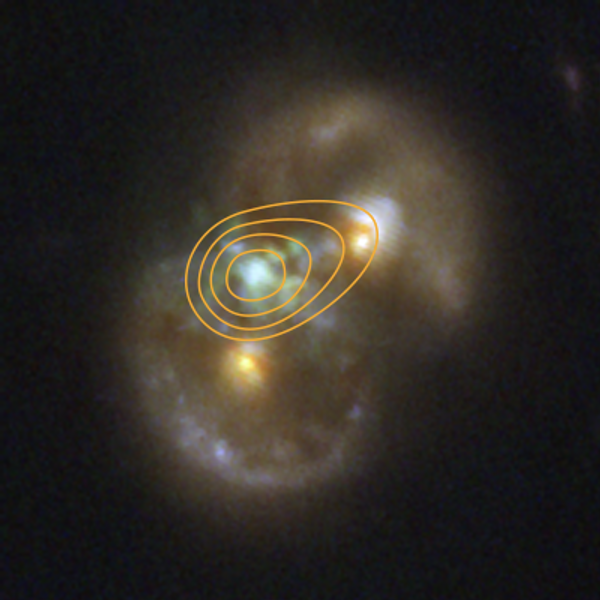
In the July 2025 JWST discovery of the Infinity Galaxy (redshift z≈0.5, but modeling early analogs), a head-on collision of two disk galaxies compressed gas into a knot that collapsed directly, forming a 10^6 solar-mass black hole amid ionized hydrogen (density n_H ~10^4 cm^{-3}, stripped of electrons by black hole radiation). Velocities measured at 50 km/s confirm the black hole sits centrally, ruling out wanderers (NASA, 2025a). This process skips stellar phases, allowing immediate growth.
Comparisons: Unlike stellar collapse (core densities 10^10 g/cm³, free-fall time seconds), direct collapse takes 10^5-10^6 years, with free-fall time τ_ff = sqrt(3π/(32 G ρ)) ~10^5 years for ρ=10^{-12} g/cm³. Fun fact: Such seeds could explain “little red dots” seen by JWST—compact, dusty galaxies at z=6-8 hosting 10^6-10^7 solar-mass black holes, glowing red from hot dust at 1000 K.
- Requirements: Pristine gas (no heavy elements >0.01% solar), halo mass 10^7 M_sun, Lyman-Werner radiation field.
- Yield: 0.1-1% of halo mass as seed, rest as quasistar envelope.
- Challenges: Rare, fraction <10^{-4} of halos; needs isolation from pollution.
Studies like Andika et al. (2024) model this yielding overmassive black holes in low-stellar-mass hosts (10^8-10^10 M_sun), matching JWST candidates at z=6.7 median.
What Recent Discoveries Solve the Early Growth Puzzle?
JWST’s infrared eyes pierce cosmic dust to reveal fast-feeding black holes at z=6-10. In November 2024, combined JWST and Chandra data uncovered a super-Eddington accretor in a dwarf galaxy 1.5 billion years post-Big Bang, with mass ~10^6 M_sun growing at 10 times Eddington, suggesting single bursts contribute 10-50% of mass (NASA, 2024). This aligns with heavy seeds, as light seeds struggle without sustained hyper-accretion.
The 64 quasar candidates from COSMOS-Web and other surveys at z=6-8, with L_bol=10^43-10^46 erg/s and M_BH=10^6-10^8 M_sun, double known low-mass examples, favoring heavy seeds (median 10^5 M_sun) with average f_Edd=0.6 and efficiency η=0.2 (Andika et al., 2024). Number densities ~10^{-5} Mpc^{-3} mag^{-1} exceed bright quasar predictions by 10x, implying diverse growth paths.
Example: The CEERS 1019 black hole at z=8.7 (570 million years old) masses 10^7 M_sun, too heavy for light seeds without extremes. Uncertainties: Accretion variability (factor 2-5) and host contamination (up to 30% in SED fits). Diagram suggestions: Luminosity function plots show faint-end rise, hinting at seed populations.
These insights suggest mergers and collapses in dense early environments accelerated growth, resolving the “too big too soon” riddle.
How Do Supermassive Black Holes Shape Galaxy Evolution?
Supermassive black holes regulate star formation through outflows: jets at 0.1c (30,000 km/s) and winds carve bubbles in gas, heating it to 10^7 K and expelling material over 100,000 light-years. In the Phoenix Cluster (z=0.6), JWST mapped how a central 10^9 M_sun black hole’s activity quenches stars in a 10^11 M_sun galaxy, reducing formation rates by 90% (NASA, 2025b).
Early on, this feedback balanced rapid growth: accretion fuels quasars that ionize intergalactic medium (density 10^{-7} cm^{-3}), aiding reionization at z=6-8. Correlations show M_BH ≈ 0.002 M_bulge, from local to z=7, per Hubble/JWST data (ESA, 2024).
Fun fact: Without this, galaxies would birth 10x more stars, becoming ultra-luminous infrared galaxies. Complex relations use scatter plots of sigma (stellar velocity dispersion, 100-300 km/s) vs. M_BH, the M-sigma relation.
Conclusion
The rapid rise of supermassive black holes from tiny seeds to galactic anchors reveals a universe where gravity, gas dynamics, and feedback intertwined from the start. Direct collapse and bursty accretion, illuminated by JWST and Hubble, explain their early dominance, linking black hole growth to galaxy assembly in the first billion years. These discoveries not only unravel the formation mystery but highlight how these invisible titans sculpted the cosmic web we see today.
As telescopes probe deeper, what new clues will emerge about the universe’s earliest heavyweights?
📌 Frequently Asked Questions
How do supermassive black holes form?
Supermassive black holes likely start as “seeds” from collapsing gas clouds or merged stellar remnants in the early universe. These seeds, weighing 10,000 to a million solar masses, then grow by pulling in gas at high rates, reaching billions of solar masses within a billion years. Recent JWST data supports direct collapse as a key path for quick formation.
When did supermassive black holes first appear?
The earliest supermassive black holes lit up quasars less than 700 million years after the Big Bang, as seen at redshift z=7.5. Hubble and JWST observations confirm active ones by 800 million years, suggesting seeds formed even earlier, around 200 million years post-Big Bang.
What is the largest known supermassive black hole?
The largest confirmed is in the galaxy Phoenix A, with about 100 billion solar masses, powering a radio galaxy. Its event horizon spans 300 billion kilometers, dwarfing our solar system. Measurements come from stellar motions and gas dynamics.
How many supermassive black holes exist in the universe?
Estimates suggest one per large galaxy, totaling around 100 billion to a trillion in the observable universe, based on galaxy counts. Most lurk quietly, but about 1% are active as quasars, detectable across billions of light-years.
Can supermassive black holes merge?
Yes, during galaxy collisions, central black holes spiral together over millions of years, merging with a burst of gravitational waves. LIGO detects stellar pairs, but future detectors like LISA will catch supermassive ones, releasing energy equal to 10 Earth masses in light.
What happens if you fall into a supermassive black hole?
Near a supermassive black hole, tidal forces are gentler than in small ones, so you might cross the event horizon intact before spaghettification stretches you over hours. Time dilation makes the fall seem instant to outsiders, but you’d experience the full plunge.
Why are supermassive black holes important to astronomy?
They anchor galaxies, regulate star birth via outflows, and probe gravity’s extremes. Studying them reveals cosmic history, from reionization to dark energy influences, as their growth tracks universe expansion.
How do astronomers detect supermassive black holes?
Detections use X-ray glow from hot accretion disks (Chandra), radio jets (VLA), gravitational lensing of background light, and star wobbles via Doppler shifts. JWST adds infrared views of dusty early ones.
What role do supermassive black holes play in galaxies?
They co-evolve with galaxies, growing in sync with stellar bulges and quenching star formation through energy feedback. This keeps massive galaxies from overproducing stars, maintaining observed cosmic balances.
Are supermassive black holes always at galaxy centers?
Nearly all are central, but wandering ones exist from mergers, roaming at 100-1000 km/s. Rare “offset” black holes, displaced by 1-10 kiloparsecs, hint at dynamic histories.
sources
(NASA, 2024). Astronomers find early fast-feeding black hole using NASA telescopes. NASA. https://www.nasa.gov/missions/chandra/astronomers-find-early-fast-feeding-black-hole-using-nasa-telescopes/
(NASA, 2025a). NASA’s Webb finds possible ‘direct collapse’ black hole. NASA Science. https://science.nasa.gov/blogs/webb/2025/07/15/nasas-webb-finds-possible-direct-collapse-black-hole/
(NASA, 2025b). Webb maps full picture of how Phoenix galaxy cluster forms stars. NASA Science. https://science.nasa.gov/missions/webb/webb-maps-full-picture-of-how-phoenix-galaxy-cluster-forms-stars/
Andika, I. T., Kartaltepe, J. S., Jahnke, K., Shuntov, M., Harish, S., Huertas-Company, M., Djorgovski, S. G., Trakhtenbrot, B., et al. (2024). Tracing the rise of supermassive black holes: A panchromatic search for faint, unobscured quasars at z ≳ 6 with COSMOS-Web and other surveys. Astronomy & Astrophysics, 686, A94. https://doi.org/10.1051/0004-6361/202349025
(ESA, 2024). Hubble finds more black holes in the early Universe. European Space Agency. https://www.esa.int/Science_Exploration/Space_Science/Hubble_finds_more_black_holes_in_the_early_Universe