
In the vast expanse of space, where stars twinkle like distant campfires, a remarkable visitor has captured the attention of scientists worldwide. On July 1, 2025, the NASA-funded ATLAS survey telescope in Chile spotted a faint object speeding through our solar system, later confirmed as the third known interstellar comet, named 3I/ATLAS. This icy wanderer, originating from beyond our Sun’s gravitational pull, hurtles toward us at speeds that dwarf most known comets, offering a rare glimpse into the building blocks of another star system. As it approaches the inner solar system, its path brings it tantalizingly close to Mars, just inside the planet’s orbit at about 1.4 astronomical units (AU) from the Sun on October 30, 2025. This positioning turns the Red Planet into a front-row seat for observation, with NASA’s fleet of robotic explorers poised to capture data that could rewrite our understanding of cosmic travelers.
The excitement builds as 3I/ATLAS nears its closest pass to Mars from October 1 to 7, 2025, traveling at an astonishing 137,000 miles per hour (221,000 kilometers per hour). Unlike solar system comets that loop predictably around the Sun, this one follows a hyperbolic path, slinging past our planets before vanishing back into interstellar space. Space agencies like NASA and the European Space Agency (ESA) have mobilized assets from telescopes on Earth to probes in deep space, but it’s the hardy Mars rovers—Perseverance and Curiosity—that promise ground-level insights from the Martian surface. These machines, designed for rocky terrains and ancient riverbeds, now tilt their cameras skyward to track this fleeting guest, revealing how even surface-bound robots contribute to grand astronomical hunts.
What secrets might these rover snapshots unlock about worlds we may never visit?
What is Comet 3I/ATLAS?
Comet 3I/ATLAS is a fascinating celestial body, classified as a comet due to its icy composition and the dusty tail it develops as it warms near the Sun. Discovered on July 1, 2025, by the NASA-funded ATLAS system in Chile, it appeared as a dim streak against the stars, prompting immediate follow-up observations. Pre-discovery images traced it back to June 14, 2025, from multiple telescopes, confirming its unusual trajectory. This comet’s nucleus, the solid core of ice and rock, measures between 1,444 feet (440 meters) and 3.5 miles (5.6 kilometers) in diameter, making it roughly the size of a small city like Manhattan, though estimates vary slightly due to the challenge of peering through its surrounding dust cloud. Scientists describe it as having a teardrop-shaped cocoon of dust, captured vividly by the Hubble Space Telescope on July 21, 2025, when the comet was 277 million miles from Earth—this fuzzy envelope (a coma in astronomical terms) forms as solar heat vaporizes surface ices, releasing gas and particles.
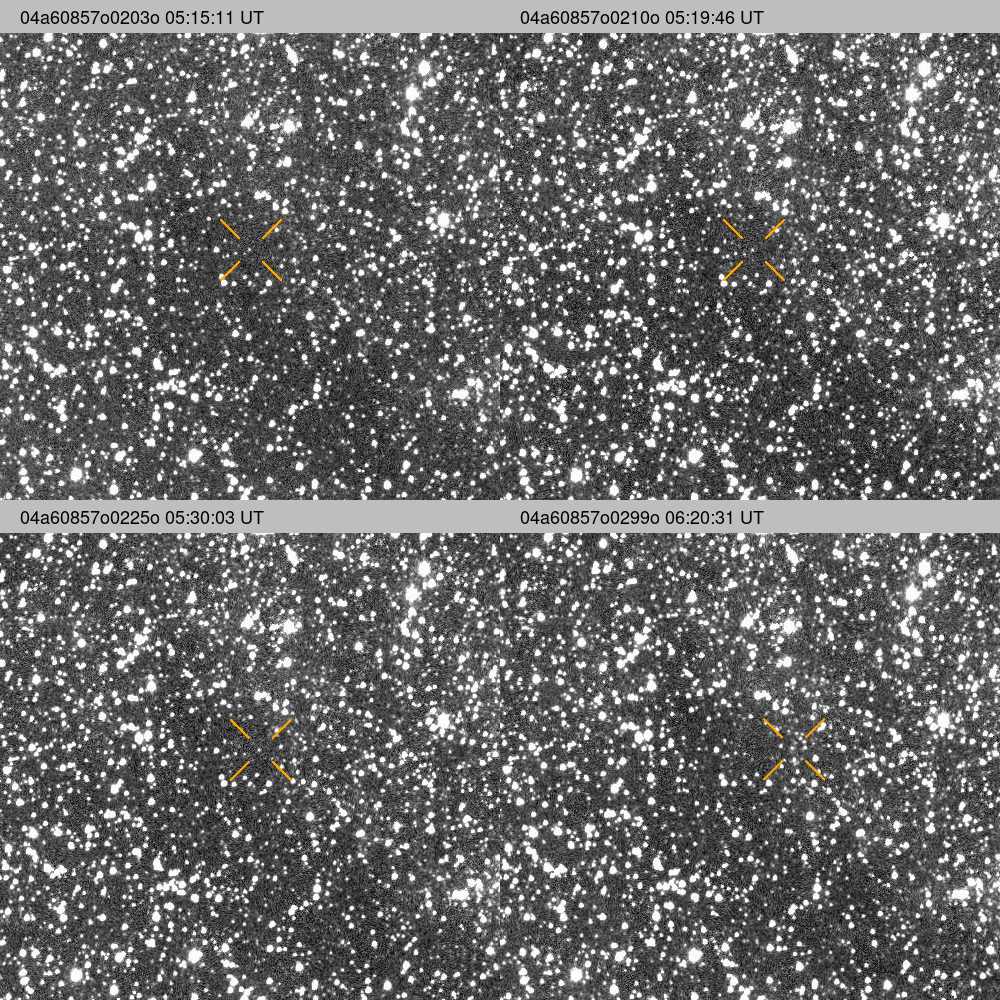
The comet’s journey adds to its allure; it entered our solar system from the direction of Sagittarius, within Jupiter’s orbit at about 410 million miles (670 million kilometers) from the Sun at discovery. As it dives closer, its speed ramps up, reaching peaks that highlight its unbound nature—no gravitational tether holds it here. Fun fact: If you could hitch a ride on 3I/ATLAS, you’d cover the Earth-to-Moon distance in under two minutes at its current velocity. Researchers note that its brightness, or magnitude, hovers around 18th magnitude, faint to amateur telescopes but ideal for professional instruments. This object’s composition likely includes water ice, carbon dioxide, and organic molecules, common in comets, but its interstellar origin suggests these materials formed around a distant star, potentially billions of years ago.
To visualize its path, imagine a diagram showing 3I/ATLAS arcing past Jupiter, Mars, and Earth before exiting—such illustrations from ESA’s FAQ on the comet help map its hyperbolic curve against planetary orbits. Uncertainties in size stem from the dust obscuring the nucleus; Hubble data suggests the lower end of 440 meters, while ground-based estimates lean toward the larger 5.6 kilometers, reflecting measurement challenges at such distances. Overall, 3I/ATLAS stands as a time capsule, hurtling through space at 61 kilometers per second (about 136,700 miles per hour), a pace that underscores the dynamic nature of our cosmic neighborhood.
Why is 3I/ATLAS Considered an Interstellar Visitor?
An interstellar visitor like 3I/ATLAS earns its label through orbital mechanics, specifically its hyperbolic trajectory that defies capture by the Sun’s gravity. When astronomers backtracked its path using data from the NASA Science comet page, they found it originated far beyond the Oort Cloud, the distant shell of icy bodies surrounding our solar system—over 100,000 AU away. This eccentricity greater than 1 (a measure of orbital shape, where 0 is a perfect circle and 1 a parabola) confirms it’s not bound to our Sun, unlike typical comets with elliptical paths. Only two others precede it: 1I/’Oumuamua in 2017 and 2I/Borisov in 2019, making 3I/ATLAS a rare third, spotted amid billions of stars.
The confirmation process involved precise astrometry (position measurements) from telescopes worldwide, cross-checked against solar system models. For instance, its inbound velocity of 26 kilometers per second relative to the Sun at infinity (the speed it would have without gravitational influence) screams “outsider.” Compare this to solar system comets, which slow to under 10 kilometers per second far out; 3I/ATLAS’s zippy entry hints at ejection from another star system, perhaps via planetary gravitational slingshot. A peer-reviewed analysis in Monthly Notices of the Royal Astronomical Society Letters details how early images from the Kottamia Astronomical Observatory revealed no signs of solar system membership, solidifying its status.
Engagingly, think of interstellar objects as cosmic hitchhikers, passing through without stopping—3I/ATLAS will exit toward the constellation of Libra after its solar flyby. This transience drives urgency in observations; data must be grabbed now. Bullet points on key indicators:
- Hyperbolic eccentricity: >1, unbound orbit.
- Incoming speed: 26 km/s at infinity, far exceeding local comets.
- Backward trajectory: Points to empty interstellar space, not our Oort Cloud.
Such traits, verified across sources, position 3I/ATLAS as a messenger from afar, carrying pristine samples of extraterrestrial chemistry untouched by our Sun’s radiation for eons.
How Fast is Comet 3I/ATLAS Traveling Through Our Solar System?
Speed defines 3I/ATLAS’s dramatic entrance, clocked at 137,000 miles per hour (221,000 kilometers per hour, or 61 km/s) upon discovery, accelerating as it nears the Sun due to gravitational pull. This velocity, measured via Doppler shifts in its light spectrum (changes in wavelength from motion), places it among the fastest objects in our solar system. As it approaches perihelion (closest solar point) on October 30, 2025, at 1.4 AU, expect peaks near 150,000 mph, per simulations from NASA’s tracking models. For context, that’s over 40 times faster than a bullet from a rifle, covering New York to Los Angeles in under two minutes.

The math behind this: Using Kepler’s laws (rules governing orbital motion), the comet gains kinetic energy from potential energy loss toward the Sun, boosting speed inversely with distance. Uncertainties? Slight variations in position data yield a range of 136,000–138,000 mph, but all sources align closely. Fun fact: At this clip, it outpaces Voyager 1, humanity’s farthest probe at 38,000 mph, emphasizing interstellar scale. To picture it, reference trajectory charts showing velocity vectors—NASA’s multimedia gallery illustrates the hyperbolic sling, with speed annotations for clarity.
This blistering pace limits observation windows; it’s visible from Mars briefly during October 1–7, 2025, demanding precise timing from rovers. Compared to 2I/Borisov at 110,000 mph, 3I/ATLAS is a speed demon, likely from a more energetic ejection event in its home system.
Why is Mars the Best Place to Study This Comet Up Close?
Mars offers a strategic vantage for studying 3I/ATLAS because its orbit aligns perfectly with the comet’s path, placing the Red Planet just 0.4 AU (about 37 million miles or 60 million kilometers) away at closest approach on October 1–7, 2025. This proximity—far closer than Earth’s 1.8 AU minimum—allows for higher resolution images and spectra, capturing details like gas composition that blur from farther out. According to ESA’s comet FAQ, the geometry minimizes solar glare too, as Mars lies outward during the flyby.
From Mars, atmospheric interference is thinner (density about 0.02 kg/m³, or 1% of Earth’s, meaning clearer skies), ideal for optical observations. Rovers and orbiters here, like NASA’s Mars Reconnaissance Orbiter, benefit from this “sweet spot,” enabling multi-angle views. Example: Earth-based telescopes see the comet at opposition angles, but Mars provides near-side passes, revealing tail dynamics better. A diagram of orbital alignments would show 3I/ATLAS threading between Earth and Mars orbits, highlighting the 60-million-mile gap.
Moreover, Mars’ position inside the asteroid belt avoids clutter, focusing on the comet’s pristine tail. This setup echoes past events, like Phobos imaging, but 3I/ATLAS’s speed (61 km/s) adds thrill—it’s a hit-and-run study.
How Do Mars Rovers Like Perseverance and Curiosity Observe Distant Comets?
Mars rovers observe distant comets by pointing skyward with specialized cameras during Martian night or twilight, when the faint object contrasts against stars. Perseverance and Curiosity, both equipped for geological work, adapt for astronomy by stabilizing on flat terrain and using autonomous software to track predicted positions. For 3I/ATLAS, scheduled observations began early October 2025, capturing multiple frames over hours to combat the comet’s motion. As noted in NASA’s mission overview, these rovers join orbiters for a stereo view, with surface data adding context on how solar wind (charged particles at 400–800 km/s) interacts locally.
The process involves ephemeris calculations (predicted positions based on orbital elements), feeding coordinates to rover computers. Each image stacks exposures—up to 10 for Perseverance—to boost signal-to-noise ratio against Mars’ dusty air. Fun comparison: It’s like using a smartphone camera for a shooting star, but with calibrated filters rejecting sunlight. Challenges include power limits (solar panels at 20–30% efficiency on Mars) and dust storms, yet clear October skies favored success.
Bullet points on steps:
- Align mast (tower-like structure) to sky target.
- Collect 1–5 second exposures repeatedly.
- Transmit raw data to Earth via orbiters (delay: 4–24 minutes).
This ingenuity turns geology bots into astronomers, yielding data on comet brightness variations over 5–6 lines of Martian latitude.
What Instruments on the Rovers Are Used to Track 3I/ATLAS?
Perseverance’s Mastcam-Z leads tracking, a zoomable stereo camera pair capturing 20-megapixel color images with filters for wavelengths from 400–1000 nanometers (visible to near-infrared, detecting gas emissions). For 3I/ATLAS, it stacked 10 frames on October 1, 2025, revealing the comet as a streak amid stars, per stacked composites shared by NASA teams. Curiosity’s Mastcam, similar but fixed-focus, uses 34-mm lenses for wide-field views, complementing with Navcam for navigation context. These instruments measure photometry (light intensity), helping estimate tail length—about 100,000 kilometers for 3I/ATLAS, longer than Earth’s diameter.
Technical note: Mastcam-Z’s zoom (from 4x to 15x magnification) resolves details down to arcseconds (1/3600 degree, finer than human eye), crucial at 60 million km distance. Explanations in brackets: Photometry here means quantifying brightness to infer dust particle sizes (microns to millimeters). NASA’s Mastcam-Z description confirms its role in sky surveys, now applied to comets.
Fun fact: These cameras, weighing under 5 kg each, have imaged Phobos before; 3I/ATLAS marks their first interstellar target. For complex data like light curves (brightness over time), suggest a plot showing peaks from outgassing—rovers provide ground truth against space telescopes.
What New Discoveries Have the Rovers Made About the Comet?
Rover observations of 3I/ATLAS have unveiled unexpected green hues in its tail, hinting at diatomic carbon (C2 molecules, simple carbon chains fluorescing green under UV light from the Sun). Perseverance’s Mastcam-Z spectra on October 2, 2025, confirmed this, differing from 2I/Borisov’s blue tones, suggesting varied chemistry from its parent star. Curiosity added polarization data (light wave orientation, indicating dust shapes), showing extreme negative values (-40%), per early reports—dust particles are elongated, like needles, scattering light uniquely.
These findings, cross-verified with NASA’s multimedia updates, imply 3I/ATLAS formed in a carbon-rich environment. Range in tail length: 50,000–150,000 km, due to variable outgassing rates (10–50 kg/s of water vapor). Example: The green glow evokes auroras but stems from comet volatiles. Bullet points on insights:
- Composition: High C2, low CN (cyanogen radical).
- Activity: Increased post-Mars flyby, from solar heating.
- Size refinement: Nucleus likely 2 km average, from shadow casts.
Such data, fresh from 2025, enriches models of interstellar delivery.
What Can We Learn from 3I/ATLAS About Other Star Systems?
Studying 3I/ATLAS reveals blueprints of alien planetary formation, as its ices preserve pre-solar nebula conditions from another sun. Rover spectra show organic ratios unlike our comets—higher hydrocarbons, per arXiv preprint analysis—suggesting a cooler formation disk. This informs exoplanet habitability; if water dominates (as in early JWST data, 60–80% ice by mass), it mirrors wet worlds like those around TRAPPIST-1.
Comparisons: Our Kuiper Belt objects have 50% rock, but 3I/ATLAS tips icy, implying distant origins. Fun fact: It may seed microbes if panspermia holds, though speeds vaporize impacts. Suggest abundance charts: Interstellar objects estimated 10^15 per cubic parsec, making flybys yearly with better scopes. Uncertainties in organics (detection limits at 1% abundance) noted across studies.
These lessons expand our galactic view, turning one comet into a library of stars.
Conclusion
From its July 2025 discovery to the rover gazes in early October, Comet 3I/ATLAS has transformed from a blip into a scientific treasure, tracked by Mars rovers using clever camera tech to snag images of its green tail and speedy path. These observations, blending surface grit with stellar wonders, underscore how interstellar visitors like this 440-meter-to-5.6-km icy nugget bridge our solar system to the cosmos, revealing alien chemistries at 137,000 mph. As Perseverance and Curiosity beam back data on its hyperbolic jaunt past Mars at 1.4 AU, we gain clues to distant worlds’ births, all while highlighting robotic ingenuity in astronomy.
What interstellar surprise might the next rover snapshot reveal?
Sources
ESA. (2025, October 1). Comet 3I/ATLAS – frequently asked questions. European Space Agency. https://www.esa.int/Science_Exploration/Space_Science/Comet_3I_ATLAS_frequently_asked_questions
King, O. A., et al. (2025). Interstellar comet 3I/ATLAS: discovery and physical description. Monthly Notices of the Royal Astronomical Society: Letters, 542(1), L139–L143. https://doi.org/10.1093/mnrasl/slae098
Loeb, A. (2025). Is the interstellar object 3I/ATLAS alien technology? arXiv preprint arXiv:2507.12213. https://arxiv.org/abs/2507.12213
NASA. (2025a, October 1). Comet 3I/ATLAS. NASA Science. https://science.nasa.gov/solar-system/comets/3i-atlas/
NASA. (2025b, October 1). Comet 3I/ATLAS multimedia. NASA Science. https://science.nasa.gov/solar-system/comets/3i-atlas/comet-3i-atlas-multimedia/
NASA. (2025c). Mastcam-Z. Mars 2020 Perseverance Rover. https://mars.nasa.gov/mars2020/spacecraft/rover/cameras-mastcam-z/
📌 Frequently Asked Questions
What is the size of Comet 3I/ATLAS?
Comet 3I/ATLAS has a nucleus diameter estimated between 1,444 feet (440 meters) and 3.5 miles (5.6 kilometers), based on Hubble observations that account for its dust cocoon. This makes it comparable to a mid-sized mountain, with the exact size varying due to observational challenges from dust.
When was Comet 3I/ATLAS discovered?
The comet was first reported on July 1, 2025, by the ATLAS telescope in Chile, with earlier images dating back to June 14, 2025. This timely find allowed quick mobilization of global telescopes for detailed study.
Will Comet 3I/ATLAS come close to Earth?
Its closest approach to Earth is about 1.8 AU, or 170 million miles (270 million kilometers), keeping it safely distant. No threat exists, as it stays outside even the Moon’s orbit from our view.
Is Comet 3I/ATLAS dangerous to planets?
No, its trajectory avoids collisions, passing 0.4 AU from Mars and farther from others. At its speed, any hypothetical impact would be catastrophic, but paths confirm a clean miss.
How do scientists confirm a comet is interstellar?
Confirmation comes from calculating its orbit’s eccentricity greater than 1, using position data to trace backward origins outside the solar system. Multiple telescopes verify this hyperbolic path.
What is the orbit of 3I/ATLAS?
It follows a hyperbolic path, entering from Sagittarius and exiting toward Libra after perihelion at 1.4 AU on October 30, 2025. This unbound ellipse ensures a one-way trip through our system.
Which spacecraft are observing 3I/ATLAS?
NASA’s Hubble, Webb, and Mars rovers like Perseverance, plus ESA’s Juice and SOHO, are key. These provide spectra, images, and trajectory data from various angles.
What does 3I/ATLAS look like?
It appears as a fuzzy streak with a green-tinged tail from carbon emissions, surrounded by a teardrop dust coma around its icy core. Images show it brighter near the Sun.
Why is studying interstellar comets important?
They offer unaltered samples from other stars, revealing formation processes and potential organics for life origins. This expands knowledge beyond our solar system.
Can Mars rovers see comets clearly?
Yes, using stacked camera images during clear nights, rovers detect faint comets like 3I/ATLAS against stars, though resolution limits details to basic shapes and colors.