Astronomers have long searched for planets beyond our solar system that might resemble vast oceans, and recent observations have spotlighted several candidates. These so-called water worlds are exoplanets where water forms a major part of their structure, potentially covering their surfaces with deep liquid layers under thick atmospheres. In 2022, data from NASA’s Hubble and Spitzer telescopes revealed two super-Earths, Kepler-138 c and d, with densities suggesting they contain significant amounts of water, up to half their volumes. This finding marked a step forward in understanding planetary diversity, as these worlds differ from anything in our solar system, where water is scarce on rocky planets.
However, the picture is evolving with new research. For instance, the exoplanet K2-18 b was initially seen as a promising hycean world—a type with a hydrogen-rich atmosphere over a global ocean—based on James Webb Space Telescope data showing methane and carbon dioxide. But a study published in September 2025 challenges this, indicating that such sub-Neptune planets likely have limited surface water due to chemical processes during formation. These updates highlight how ongoing missions refine our knowledge of distant worlds.
What if some exoplanets truly are endless oceans, and how might that change our view of life in the universe?
What Are Water World Exoplanets?
Water world exoplanets refer to planets where water dominates the composition, often forming deep oceans that could span thousands of kilometers. Unlike Earth, where oceans average just 4 kilometers in depth and make up less than 1 percent of the planet’s mass, these worlds might have water layers accounting for 10 to 50 percent of their total mass. Scientists define them as having low densities compared to rocky planets, indicating materials lighter than rock but heavier than gas giants’ hydrogen-helium mixes. For example, a planet with a density around 1 to 2 grams per cubic centimeter (g/cm³, a measure of mass per volume) suggests abundant water or ice.
These exoplanets form in various ways, typically from ice-rich materials beyond a star’s snow line—the distance where water freezes in the protoplanetary disk (the swirling gas and dust around a young star). As they migrate closer to their star, the ice melts into liquid or vapor. High-pressure conditions deep inside could turn water into exotic forms like supercritical fluid (a state where liquid and gas phases blend at extreme temperatures and pressures, above 374°C and 218 atmospheres). This makes water worlds distinct from mini-Neptunes, which have thick gas envelopes, or super-Earths, which are mostly rock.
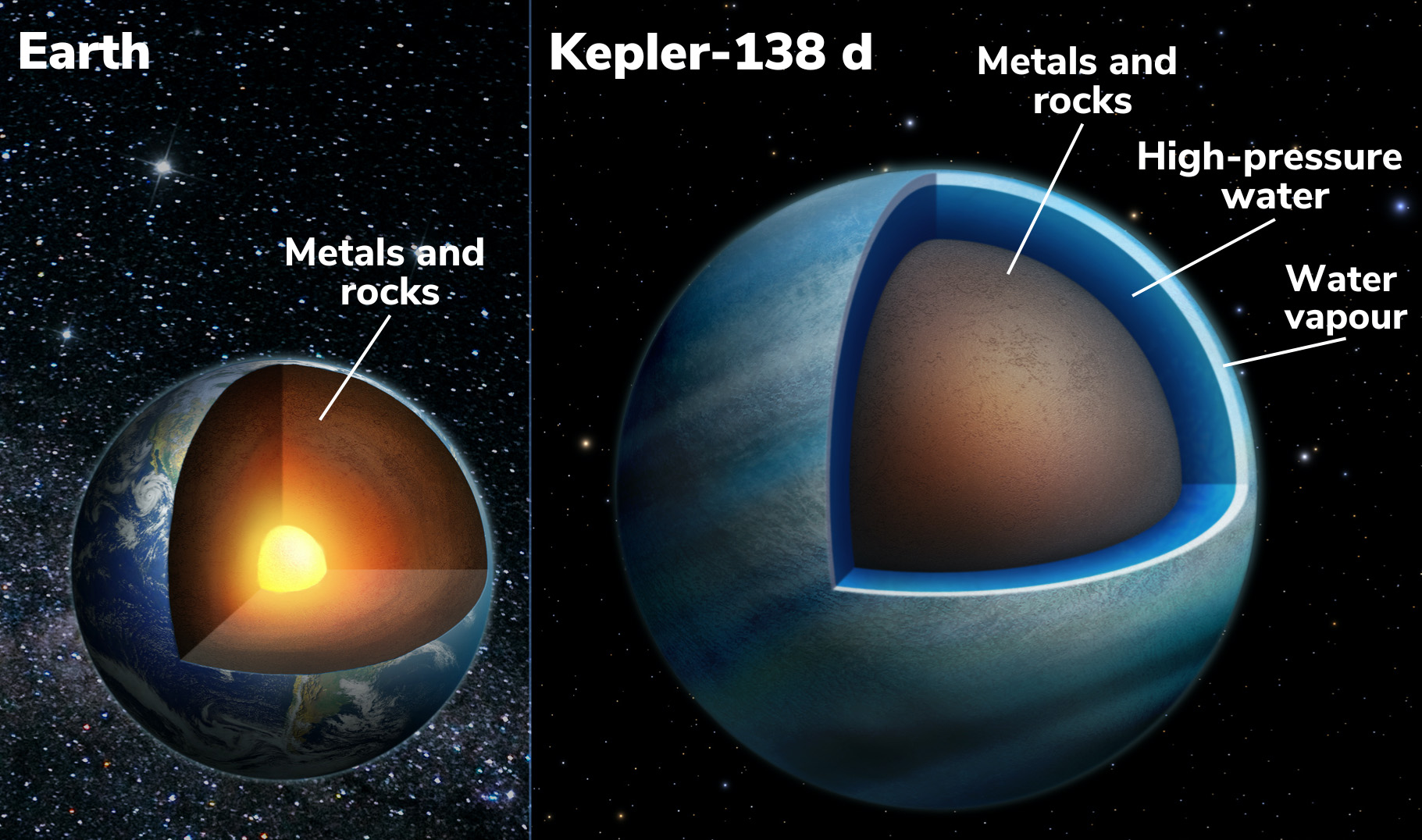
To visualize, consider a cross-section: a small rocky core surrounded by high-pressure ice mantles, topped by liquid oceans and steam atmospheres. Fun fact: if a water world like this had Earth’s gravity, diving into its ocean might never reach a bottom, as pressure increases with depth. Bullet points on key traits:
- Mass: Often 1 to 10 times Earth’s mass.
- Radius: 1.5 to 2.5 times Earth’s radius (about 6,371 km).
- Temperature: Equilibrium temperatures (average without atmosphere) from 200 to 500 Kelvin (K, where 273 K is 0°C).
- Composition: Water as H2O, possibly mixed with ammonia or methane ices.
Recent models show uncertainties; for instance, some planets thought to be water-rich may instead lock water in their interiors. According to NASA’s analysis of Kepler-138 planets, their low densities confirm water dominance, but broader studies suggest ranges in water content due to formation variations.
How Do Scientists Discover Water World Exoplanets?
Detecting water worlds involves multiple techniques, starting with the transit method, where a planet passes in front of its star, causing a dip in brightness. Telescopes like NASA’s Kepler and TESS measure this to find planet sizes. To infer composition, astronomers calculate density by combining size with mass, obtained via radial velocity (measuring star wobble from planetary gravity) or transit timing variations (subtle shifts in transit times due to sibling planets’ pulls).
For water detection, spectroscopy analyzes starlight filtering through the planet’s atmosphere during transits, identifying molecules like water vapor. The James Webb Space Telescope excels here, using infrared to spot chemical signatures. For example, in Kepler-138 d, Hubble and Spitzer data showed a radius of about 1.6 Earth radii and mass of 2 Earth masses, yielding a density of roughly 2 g/cm³—half Earth’s 5.5 g/cm³—pointing to water.
Challenges include distinguishing water from other light materials, like hydrogen envelopes. Comparisons help: a pure rock planet would have higher density, while gas mini-Neptunes have lower. Fun fact: the first hint of exoplanet water came from HAT-P-11 b in 2014, with vapor detected, but it was not a full water world. Bullet points on discovery steps:
- Survey for transits to get radius.
- Use ground telescopes for mass via Doppler shift (star movement up to meters per second).
- Model interiors with equations of state (how materials behave under pressure).
- Confirm with follow-up observations for atmosphere.
If data shows inconsistencies, like slightly varying densities across sources, scientists note uncertainties from measurement errors, typically 10-20 percent. Suggest viewing a density-radius plot to see where water worlds cluster.
Which Exoplanets Are Candidates for Water Worlds?
Several exoplanets stand out as potential water worlds based on current data. Kepler-138 d, 218 light-years away, has a mass of 2 Earth masses and radius 1.6 times Earth, with models indicating water layers up to 2,000 km deep. Its twin, Kepler-138 c, shares similar traits, both orbiting a red dwarf star. These are not habitable due to close orbits, with surface temperatures likely above 100°C.
TOI-1452 b, discovered in 2022 by TESS, is another strong candidate at 100 light-years in the Draco constellation. With a mass of 4.82 Earth masses and orbit of 11.1 days at 0.061 AU (astronomical units, Earth’s distance from the Sun), its density suggests a thick water ocean. Observations indicate it receives moderate heat, making it a prime target for Webb telescope studies.
K2-18 b, 124 light-years distant, was highlighted as a hycean candidate with possible oceans under a hydrogen atmosphere. JWST data in 2024 detected methane and carbon dioxide, but no water directly. However, a September 2025 peer-reviewed paper argues sub-Neptunes like it have limited surface water, with most locked in the core. Densities range 1.5-2.5 g/cm³, but chemical models show only a few percent H2O at the surface.
L 98-59 f, confirmed in 2025, is a super-Earth 35 light-years away with 2.8 Earth masses and a 23-day orbit in the habitable zone. While not definitively water-dominated, its position suggests potential for liquid water if an atmosphere exists. Bullet points on candidates:
- Kepler-138 d: Density 2 g/cm³, water fraction up to 50 percent.
- TOI-1452 b: Possible global ocean, equilibrium temperature around 300 K.
- K2-18 b: Radius 2.6 Earth radii, mass 8.6 Earth masses.
- L 98-59 f: Receives Earth-like stellar flux (energy per area).
Measurements vary slightly; for K2-18 b, mass estimates range 8-9 Earth masses due to observational precision.
Could Water World Exoplanets Support Life?
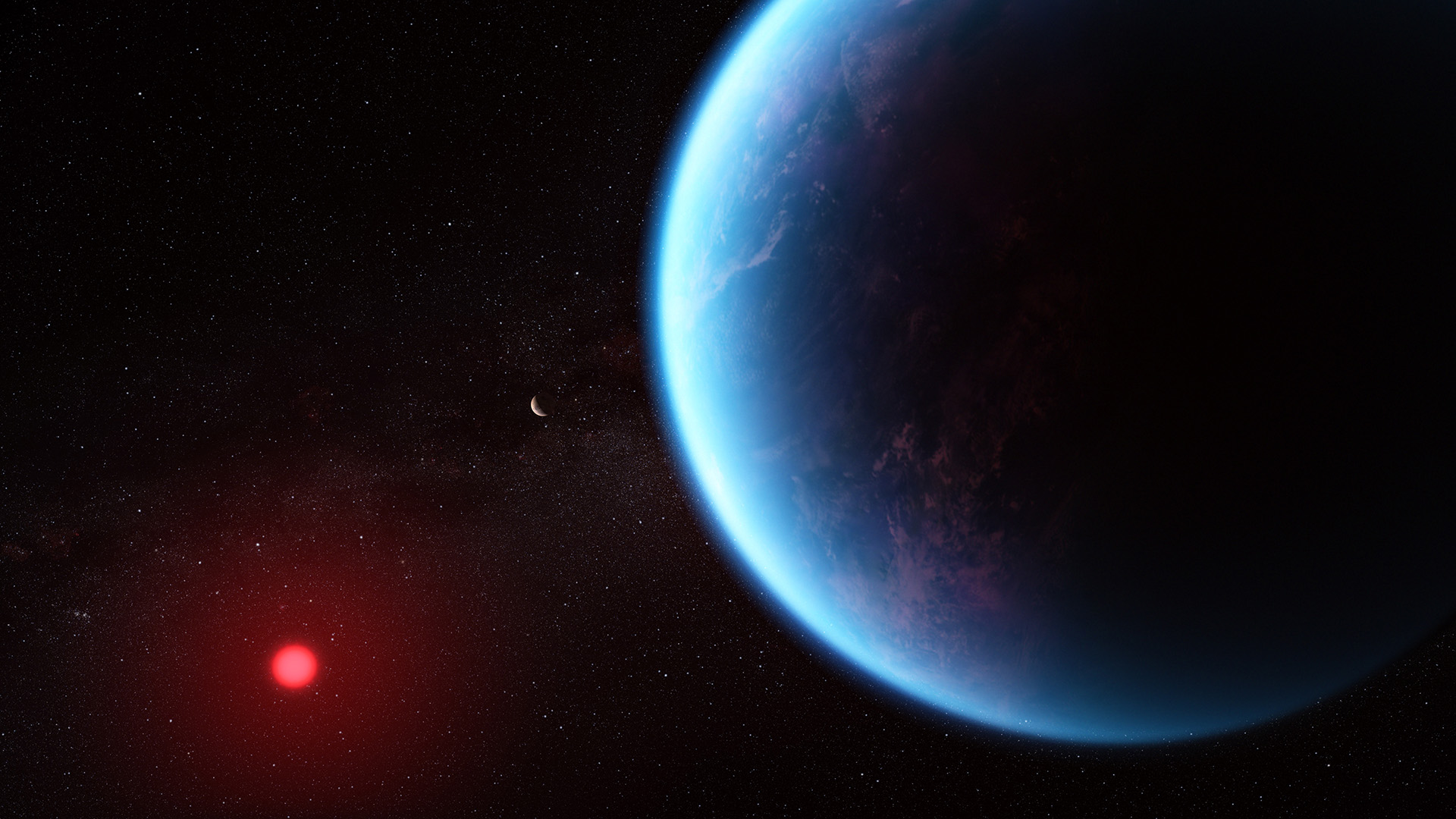
Habitability on water worlds depends on stable liquid water, energy sources, and chemistry for biology. Hycean types like K2-18 b could host life in oceans beneath hydrogen atmospheres, with temperatures allowing liquid water (0-100°C at standard pressure, but higher under pressure). However, without land, nutrient cycling might differ—no rock weathering to supply minerals like phosphorus.
According to NASA’s Webb telescope reconnaissance, K2-18 b shows possible dimethyl sulfide, a biosignature from marine organisms, but the signal is weak. Deep oceans could have hydrothermal vents (seafloor hot springs) providing energy, similar to Earth’s deep-sea life.
Challenges include runaway greenhouse effects, where thick steam atmospheres trap heat, boiling oceans. For L 98-59 f, in the habitable zone, mild temperatures (around 300 K) might allow life if water exists. Fun fact: on a pure water world, pressure at 10 km depth equals Earth’s ocean trenches, supporting extremophiles (organisms in extreme conditions).
Uncertainties arise; recent models suggest limited surface water, reducing habitability odds. If complex, suggest a habitability index chart comparing factors like temperature and composition. Bullet points on life potential:
- Pros: Vast water volumes for biochemistry.
- Cons: No continents for diverse ecosystems.
- Key factor: Atmospheric protection from stellar radiation.
What Challenges Do Researchers Face in Studying Water Worlds?
Studying water worlds involves overcoming distance and faint signals. Exoplanets are light-years away, so direct imaging is rare; most data comes from indirect methods. Atmospheric hazes can obscure spectroscopy, as seen in K2-18 b observations where water vapor was not detected despite expectations.
Technological advances help, like Webb’s MIRI instrument (mid-infrared) for deeper probes. However, models have uncertainties; density calculations can vary 10 percent due to assumptions about core composition. For instance, Kepler-138 d’s water layer depth is estimated at 2,000 km, but ranges 1,500-2,500 km across studies.
International collaboration, including ESA’s contributions, enhances data. Fun fact: simulating a water world’s interior requires supercomputers to model phase transitions (changes in state) under gigapascals (billions of pascals, unit of pressure).
To aid understanding, reference interior structure diagrams showing layers. Bullet points on challenges:
- Signal noise from host stars.
- Distinguishing water from other volatiles (easily evaporated substances).
- Need for more transits to build data.
According to recent ETH Zurich research on sub-Neptunes, chemical interactions reduce water availability, urging revised models.
Conclusion
Water world exoplanets represent a fascinating class of worlds where deep oceans could redefine planetary science, with candidates like Kepler-138 d and K2-18 b offering glimpses into diverse compositions. While early data suggested abundant water, recent 2025 findings indicate many may be drier, with water trapped inside, challenging habitability ideas. Ongoing missions continue to uncover truths about these distant oceans.
Could future telescopes reveal a true water world teeming with life, or will they remain elusive mysteries?
📌 Frequently Asked Questions
What is a water world exoplanet?
A water world exoplanet is a planet where water makes up a large portion of its mass, often with global oceans deeper than Earth’s. These worlds have low densities indicating thick water layers, and they differ from rocky or gaseous planets in our solar system.
Is K2-18 b a water world?
K2-18 b was considered a hycean world with possible oceans, based on detections of methane and carbon dioxide. However, new research shows it likely lacks a deep global ocean, with most water bound in the interior due to formation processes.
What is the closest water world to Earth?
TOI-1452 b, about 100 light-years away, is one of the nearest candidates, potentially covered in water. L 98-59 f, at 35 light-years, is even closer and in a habitable zone, though its water content is not confirmed.
How deep are oceans on water world exoplanets?
Oceans on these planets could reach depths of 2,000 kilometers or more, far beyond Earth’s 11 km maximum. High pressure turns lower layers into ice or supercritical fluid, creating unique environments.
Can water worlds have atmospheres?
Yes, many have thick atmospheres of steam, hydrogen, or carbon dioxide that protect the surface. For example, Kepler-138 d likely has a steam envelope above its water layers.
Are there any confirmed water worlds?
No exoplanets are fully confirmed as water worlds, but candidates like Kepler-138 c and d have strong evidence from density measurements. Confirmations require more atmospheric data from telescopes like Webb.
What makes a planet a hycean world?
Hycean worlds are super-Earths with hydrogen atmospheres over liquid oceans, potentially habitable. They bridge rocky planets and mini-Neptunes, with temperatures allowing liquid water.
How do water worlds form?
They form from ice-rich materials in outer disks, migrating inward where ice melts. Chemical reactions during magma phases influence water distribution, often locking it inside the planet.
Could life exist on water worlds without land?
Life might thrive in deep oceans via chemical energy from vents, similar to Earth’s seafloor. Without land, ecosystems could rely on floating organisms or dissolved nutrients.
What recent discoveries have been made about water worlds?
In 2025, studies showed sub-Neptunes are drier than thought, reducing water world candidates. Earlier, 2022 findings on Kepler-138 planets highlighted water-rich compositions.
Sources
NASA. (2022, December 15). Two Super-Earths May Be Mostly Water. NASA Science. https://science.nasa.gov/universe/exoplanets/two-super-earths-may-be-mostly-water/
NASA. (2024, June 5). Reconnaissance of Potentially Habitable Worlds with NASA’s Webb. NASA Science. https://science.nasa.gov/blogs/webb/2024/06/05/reconnaissance-of-potentially-habitable-worlds-with-nasas-webb/
Werlen, A., Dorn, C., Burn, R., Schlichting, H. E., Grimm, S. L., & Young, E. D. (2025). Sub-Neptunes Are Drier than They Seem: Rethinking the Origins of Water-rich Worlds. The Astrophysical Journal Letters, 991(1), L16. https://doi.org/10.3847/2041-8213/adff73