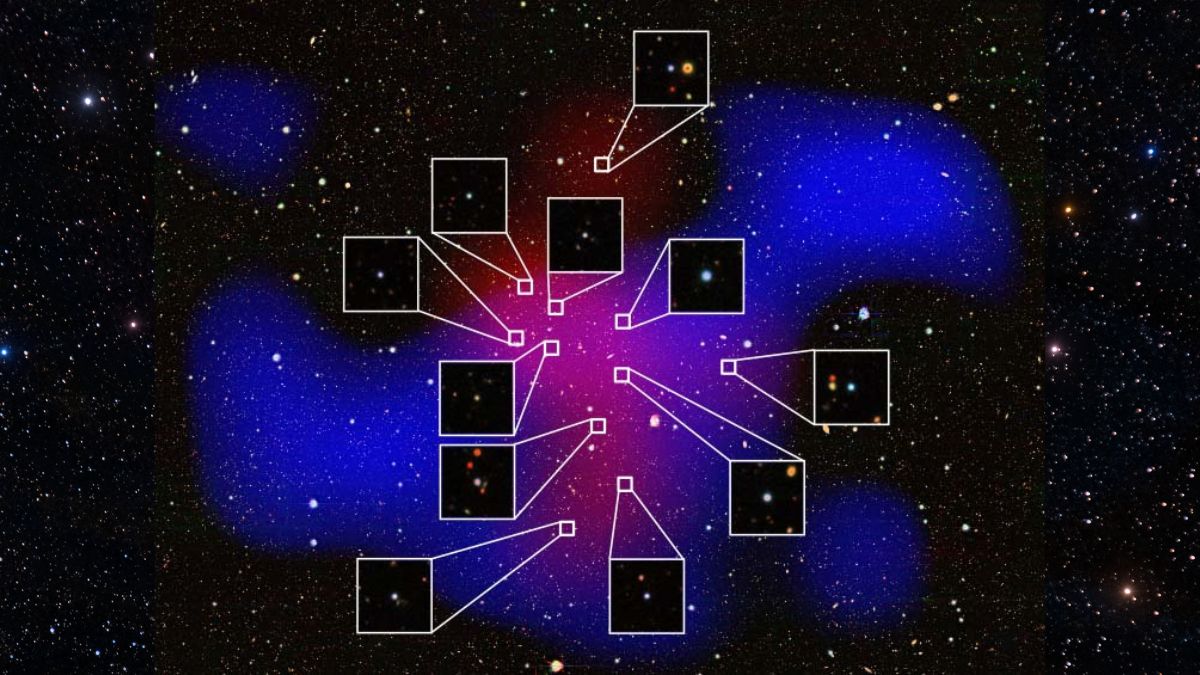
Astronomers have uncovered the densest concentration of supermassive black holes ever observed, a remarkable grouping of 11 quasars that challenges existing models of cosmic structure formation. Located in the constellation Cetus, this cluster dates back 10.8 billion years and spans a compact volume where such an aggregation was previously unimaginable. Dubbed the “Cosmic Himalayas,” the structure marks a boundary between evolving cosmic regions, much like Earth’s mountain range divides plains from plateaus.
The discovery stems from an analysis of data spanning nearly 10,000 square degrees of sky surveyed by the Sloan Digital Sky Survey (SDSS) and its extension, eBOSS. Within a redshift range of z = 2.16 to 2.20, the team identified this overdensity in the BOSSJ0210 field, where the quasar number density reaches 30 times the survey average. This yields a statistical significance of 17 sigma, surpassing prior records of four or five quasars in similar volumes by a factor of two to three.
The quasars, each powered by supermassive black holes with luminosities exceeding M_UV = -23, cluster within a (40 comoving megaparsec)^3 volume. Unlike expectations, this peak does not align with peaks in galaxy distributions or neutral hydrogen (H I) densities in the intergalactic medium (IGM). Observations from the Subaru Telescope’s Hyper Suprime-Cam reveal two distinct galaxy density peaks about 25 h^{-1} comoving megaparsecs northwest and southeast of the quasar site, as mapped from 465 galaxies in the MAMMOTH-Subaru survey.
Yongming Liang, lead author from the University of Tokyo and the National Astronomical Observatory of Japan (NAOJ), explained the naming: “That’s why we named it the Cosmic Himalayas. It stands out like a mountain range separating distinct structures in the early Universe.” The quasars reside near the edge of regions with varying IGM opacity, where more luminous ones occupy zones with lower H I content.
To map the IGM, researchers constructed a three-dimensional H I tomography using Lyα forest absorption in spectra from 23 background quasars, achieving a spatial resolution of 15 h^{-1} comoving megaparsecs in projection. This revealed the quasar overdensity at the border between opaque (H I-rich) and transparent (ionized) volumes. The leftward galaxy clump correlates with high neutral gas density, while ionized gas prevails around the rightward clump. Yet, the quasars show no direct overlap with these features, suggesting they thrive in transitional environments.
This discrepancy prompts a reevaluation of quasar formation mechanisms. Standard scenarios posit that supermassive black holes cluster in dense galaxy groups, where mergers and gas inflows fuel their activity. Here, the quasars appear decoupled from such peaks, possibly indicating preferential ignition in lower-density IGM boundaries. As Liang noted in the study, “Current physical scenarios with mixtures of H I overdensities and quasar photoionization cannot fully interpret the emergence of the Cosmic Himalayas.”
Further evidence comes from the quasars’ coherent activity: all 11 are in luminous phases, an improbable coincidence under random activation models. The structure’s position at cosmic web filaments’ intersections may enhance gas flows without concentrating galaxies excessively. Subaru imaging highlights hundreds of young, star-forming galaxies nearby, but their distribution avoids the quasar core, reinforcing the spatial offset.
The peer-reviewed findings, detailed in a paper published in The Astrophysical Journal, underscore the need for refined simulations incorporating IGM-quasar feedback. Cosmic Himalayas quasar overdensity analysis integrates multiwavelength data, from SDSS photometry to Subaru deep fields, to delineate these anomalies.
NAOJ’s press release emphasizes the discovery’s implications: “This structure cannot be explained by conventional theories, forcing astronomers to rethink the formation scenarios for quasars.” Observations rule out foreground contamination or selection biases, as the quasars meet uniform SDSS criteria for rest-UV magnitude and redshift.
In closing, the Cosmic Himalayas illuminate gaps in our understanding of early universe dynamics, offering a prime testbed for interplay among galaxies, quasars, and the IGM. Future surveys with next-generation telescopes will probe whether such clusters seed larger cosmic features.
References
Liang, Y., et al. (2025). Cosmic Himalayas: The highest quasar density peak identified in a 10,000 deg² sky with spatial discrepancies between galaxies, quasars, and IGM H I. The Astrophysical Journal, 986(1), 60. https://doi.org/10.3847/1538-4357/adc1bb
National Astronomical Observatory of Japan. (2025, June 3). Cosmic Himalayas quasar cluster defies explanation. https://www.nao.ac.jp/en/news/science/2025/20250603-subaru.html