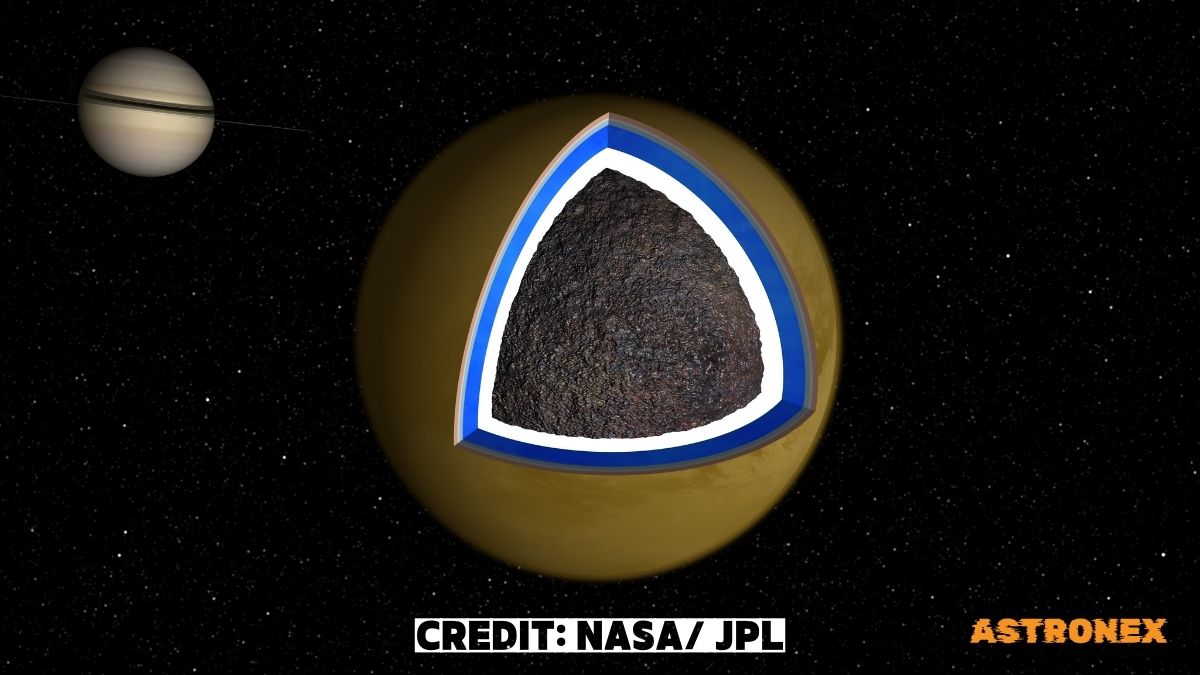
Scientists studying Saturns largest moon Titan have uncovered intriguing clues about its hidden depths through data from past space missions. For years experts believed that beneath Titans icy exterior lies a vast ocean of liquid water potentially mixed with other substances making it a prime target for understanding environments beyond Earth. This belief stems from observations gathered by NASAs Cassini spacecraft which orbited Saturn from 2004 to 2017 revealing gravitational anomalies and rotational behaviors that pointed to a subsurface layer of liquid. Such discoveries have sparked excitement in the astronomical community as they suggest Titan could harbor conditions similar to those on early Earth where life might emerge. Recent analyses however have introduced new perspectives on these findings prompting researchers to reevaluate the data with advanced techniques.
The initial evidence came from precise measurements of Titans gravity field and how the moon responds to Saturns tidal forces causing slight deformations in its shape. These deformations indicated that Titans interior is not entirely solid but includes a flexible layer that allows the surface to shift independently from the core. According to NASAs detailed facts on Titan this suggests an underground ocean of liquid water likely containing salts and ammonia located about 55 to 80 kilometers below the icy crust. The European Space Agencys Huygens probe which landed on Titan in 2005 also detected radio signals during its descent that supported the presence of this hidden ocean adding to the body of evidence from collaborative missions. As researchers continue to probe these datasets the story of Titans interior evolves highlighting the dynamic nature of planetary science.
What if the ocean thought to exist deep within Titan is not as straightforward as once believed sparking debates about its current state and implications for habitability?
What Evidence Suggests the Presence of a Subsurface Ocean on Titan?
Data from the Cassini mission provided the foundational evidence for a subsurface ocean on Titan through gravitational mapping and radar observations. During multiple flybys the spacecraft measured how Titans gravity field varies revealing that the moons density distribution is inconsistent with a fully solid body. Instead the data showed a lower density layer beneath the ice shell which scientists interpreted as a liquid ocean. This interpretation aligns with models of icy moons where internal heat from radioactive decay and tidal friction maintains liquid water despite the cold surface temperatures around minus 179 degrees Celsius. For instance comparisons to Earths Antarctic lakes under ice sheets help illustrate how such oceans could persist isolated from the atmosphere above.
Further support came from Titans rotational dynamics observed over time. The moon rotates slightly faster than expected for a synchronous lock with Saturn suggesting that its crust is decoupled from the denser core by a viscous liquid layer. According to ESAs report on Titans potential ocean radar tracking of surface features like lakes and mountains showed displacements up to 30 kilometers indicating tidal bulging and flexing of the ice shell. These shifts measured between 2005 and 2007 during Cassinis passes imply an ocean depth allowing for such movement much like how Earths oceans respond to lunar tides but on a planetary scale. Fun fact Titans tidal bulges can reach heights of about 10 meters comparable to some coastal tides on our planet enhancing the intrigue of this distant world.
In addition the Huygens probes atmospheric descent data included extremely low frequency radio waves that resonated in a way consistent with a conductive layer below the surface. This conductivity could arise from salty water acting as an electrolyte similar to seawater on Earth. Researchers cross checked these findings with computer simulations of Titans interior structure confirming that without a subsurface ocean the observed gravity and rotation data would not match. While early models estimated the ocean to be global and hundreds of kilometers thick they emphasized the need for ongoing verification. Bullet points of key evidence include
- Gravitational anomalies showing density variations
- Rotational asynchrony indicating crust core decoupling
- Radio signal detections suggesting conductivity
- Surface feature displacements from tidal forces
- Consistency with thermal models of internal heating.
These elements combined paint a picture of a dynamic interior but recent studies have begun to question the certainty of a fully liquid global ocean.
How Deep Might Titans Subsurface Ocean Be Located?
Estimates of the depth to Titans potential subsurface ocean vary based on the data analyzed but generally place it between 50 and 100 kilometers beneath the surface ice. Gravity measurements from Cassini indicated that the ice shell is relatively thin allowing tidal forces to deform it significantly. In models without an ocean the shell would need to be much thicker to explain the moons moment of inertia a measure of mass distribution (calculated as 0.343 times mass times radius squared). This thin shell about 170 kilometers in some recent interpretations sits atop what was thought to be liquid water. For non experts moment of inertia is like how a figure skater spins faster with arms pulled in showing how mass is spread out in a body.
Drawing from collaborative NASA and ESA data the ocean layer itself could extend for hundreds of kilometers potentially reaching depths of 500 kilometers or more toward the rocky core. According to NASAs Titan facts overview the Huygens probe suggested a depth of 55 to 80 kilometers for the top of the ocean based on radio wave propagation speeds (measured in hertz for frequency). These waves traveled through the atmosphere and reflected off subsurface boundaries providing clues to layer thicknesses. Comparisons to Enceladus another Saturn moon with confirmed plumes show Titans ocean might be deeper and more insulated explaining the lack of surface geysers. A fun analogy think of Titans ice shell as a thick blanket over a warm pool keeping the liquid hidden from view.
However uncertainties exist due to variations in assumed ice rigidity the stiffness of the material measured in pascals a unit of pressure. If the ice is more rigid estimates push the ocean deeper while softer ice suggests shallower depths. Cross checking across sources like peer reviewed models shows a range of 50 to 200 kilometers for the ice thickness with most converging around 100 kilometers. To visualize this researchers often reference diagrams of layered planetary interiors where colors denote ice liquid and rock helping readers grasp the scale. Titan with a radius of 2575 kilometers makes this ocean a significant fraction of its volume potentially holding more water than all of Earths oceans combined if confirmed.
What is the Likely Composition of Titans Subsurface Ocean?
The subsurface ocean on Titan is believed to consist primarily of liquid water with additions of ammonia and salts creating a briny mixture that lowers the freezing point. Ammonia acts as an antifreeze allowing the water to remain liquid at temperatures well below zero degrees Celsius much like how salt keeps roads ice free in winter. Data from Cassinis mass spectrometer detected traces of these compounds in the upper atmosphere hinting at upward migration from below. The salinity could be as high as Earths Dead Sea based on gravity data implying densities around 1000 to 1200 kilograms per cubic meter. This composition supports habitability as it provides solvents for chemical reactions essential for life.
Further analysis of Titans magnetic field or lack thereof suggests the ocean is conductive due to dissolved ions from salts. Without such conductivity the moons interaction with Saturns magnetosphere would differ from observations. According to models referenced in agency reports the ammonia content might be up to 15 percent by volume preventing full freezing under pressure. Comparisons to lab experiments on Earth show that water ammonia mixtures can stay liquid at minus 100 degrees Celsius relevant to Titans interior conditions. A fun fact this mixture might resemble some industrial coolants used in refrigeration systems bridging space science to everyday technology.
Uncertainties in composition arise from indirect measurements as no direct sampling has occurred. If methane or other hydrocarbons seep into the ocean from the surface they could form clathrates cage like structures trapping gases adding complexity. Bullet points for composition include
- Main component water
- Additives ammonia salts
- Density range 1000 to 1200 kg per m3
- Freezing point depression due to solutes
- Potential for organic interactions.
These details underscore Titans ocean as a unique chemical environment but recent reanalyses question if its fully liquid or partially frozen.
Does Recent Research Challenge the Idea of a Subsurface Ocean on Titan?
In late 2025 a reanalysis of Cassini data challenged the long held view of a global subsurface ocean on Titan suggesting instead that strong tidal dissipation occurs in a solid high pressure ice layer. This dissipation measured through tidal Love numbers a dimensionless quantity describing deformation shows values too high for an ocean model. Specifically the real part of k2 is 0.608 plus or minus 0.048 and the imaginary part is 0.135 plus or minus 0.035 indicating a quality factor Q of about 4.5 far lower than expected for a liquid separated body. According to the peer reviewed study in Nature on Titans tidal dissipation this implies energy loss of 3 to 4 terawatts mostly in ice rather than liquid ruling out a current global ocean.
The study used improved data processing techniques from later missions like Juno reducing noise in radio tracking signals. Models without an ocean fit the gravity field rotation and eccentricity better proposing a 170 kilometer low pressure ice shell over 378 kilometers of high pressure ice near its melting point. This setup allows convection heat driven flow to remove tidal heat without melting similar to mantle convection on Earth. Experts note that while past evidence supported an ocean the new fit explains all data consistently including Titans obliquity the tilt of its axis at 0.32 degrees. A fun comparison this debate mirrors historical shifts in understanding Mars water from canals to subsurface ice.
Implications include the possibility of a past ocean that froze leaving slushy pockets with liquid volumes akin to Earths Atlantic Ocean. Uncertainties remain as multiple sources show slight differences in Love number estimates with ranges reflecting data precision. To aid understanding diagrams of interior models with and without oceans are suggested showing layer thicknesses and heat flows. This research highlights the evolving nature of science where reexamination can refine or overturn previous conclusions.
What Could a Subsurface Ocean Mean for Potential Life on Titan?
If a subsurface ocean exists on Titan it could provide a stable environment for prebiotic chemistry the building blocks of life due to its isolation from harsh surface conditions. Water as a solvent would allow organic molecules abundant on Titans surface from methane rains to dissolve and react potentially forming complex structures. Ammonia and salts might supply nitrogen and minerals needed for biological processes similar to hydrothermal vents on Earths seafloor where life may have originated. The oceans depth would shield it from cosmic radiation enabling long term stability for any microbial life forms.
Comparisons to Europa and Enceladus show that such oceans often have energy sources from tidal heating driving chemical gradients. On Titan this could manifest as cryovolcanism ice volcanoes erupting water ammonia mixtures. Fun fact lab experiments simulating Titan conditions have produced amino acids the components of proteins suggesting habitability potential. However without direct evidence life remains speculative. Bullet points for implications include
- Solvent for organics
- Energy from tides
- Protection from radiation
- Analogy to Earth vents
- Potential for cryovolcanism.
Even if recent studies suggest no global ocean localized melt pockets could still host life concentrating resources in smaller volumes.
What Future Missions Plan to Explore Titans Subsurface Ocean?
NASAs Dragonfly mission set to launch in 2028 and arrive in 2034 aims to investigate Titans surface and subsurface with a drone like rotorcraft. It will carry instruments for seismometry measuring vibrations to probe interior layers much like earthquakes reveal Earths core. This could confirm or refute ocean models by detecting wave speeds in pascals per second faster in solids than liquids. Other tools include mass spectrometers to analyze composition and drills for sampling ice potentially accessing ocean influenced materials.
The mission focuses on organic rich dunes and impact craters where subsurface materials might be exposed. According to agency plans Dragonfly will hop across sites covering dozens of kilometers over two years. Comparisons to Mars rovers show how mobility enhances data collection. While not directly sampling the ocean it could detect signs like magnetic anomalies or gas emissions. A fun fact the rotorcraft design draws from helicopter technology adapted for Titans thick atmosphere allowing flight despite low gravity.
Uncertainties in mission data will depend on landing site selection but models predict valuable insights into ice thickness around 100 kilometers. Visual aids like mission trajectory maps are recommended to illustrate the exploration strategy. This endeavor builds on Cassini laying groundwork for understanding Titans hidden depths.
Conclusion
The evidence for liquid water deep beneath Titans surface primarily from Cassini gravity rotation and radio data has painted it as a potential ocean world but recent 2025 reanalyses suggest a solid ice interior with possible past or localized liquids. This evolution in understanding highlights the importance of refined data processing and models in planetary science balancing excitement with caution. Titans subsurface remains a key focus for exploring habitability in the outer solar system.
Could future missions like Dragonfly uncover definitive proof reshaping our view of icy moons forever?
(NASA, 2025) (Petricca et al., 2025) (European Space Agency, 2008)
Sources
European Space Agency. (2008, March 20). Ocean may exist beneath Titan’s crust. European Space Agency. https://www.esa.int/Science_Exploration/Space_Science/Cassini-Huygens/Ocean_may_exist_beneath_Titan_s_crust
NASA. (2025, April 25). Titan: Facts. NASA Science. https://science.nasa.gov/saturn/moons/titan/facts/
Petricca, F., Vance, S. D., Parisi, M., Buccino, D., Cascioli, G., Castillo-Rogez, J., Downey, B. G., Nimmo, F., Tobie, G., Journaux, B., Magnanini, A., Jones, U., Panning, M., Bagheri, A., Genova, A., & Lunine, J. I. (2025, December 17). Titan’s strong tidal dissipation precludes a subsurface ocean. Nature. https://www.nature.com/articles/s41586-025-09818-x