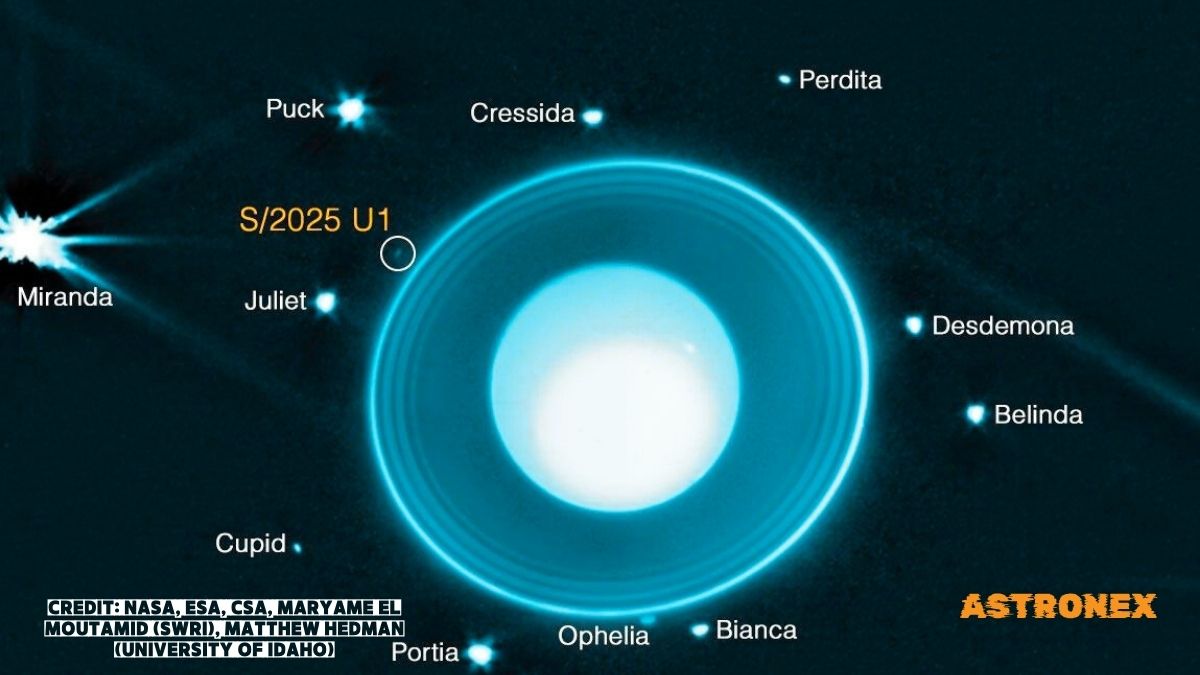
Astronomers have uncovered a fascinating addition to the Uranian system through advanced telescope observations. In early 2025, data from the James Webb Space Telescope revealed a tiny satellite that had evaded detection for decades. This small body, provisionally named S/2025 U1, marks the 29th known moon around Uranus, expanding our knowledge of this distant ice giant’s complex environment. The discovery highlights how modern instruments continue to peel back layers of mystery in the outer solar system, building on past missions that first glimpsed Uranus up close.
The finding came from a dedicated survey aimed at probing the faint features around Uranus, including its rings and inner satellites. Using infrared imaging, scientists spotted this elusive object amid the planet’s bright glow and surrounding structures. With Uranus located about 1.8 billion miles from the sun on average, such detections require exceptional sensitivity to capture light from dim, distant worlds. This new moon joins a family of small inner satellites that interact closely with the planet’s ring system, offering clues to their shared origins.
What secrets might this tiny moon hold about the formation and evolution of Uranus and its companions?
What Is the Newly Discovered Moon Around Uranus?
The newly discovered moon, known as S/2025 U1, represents a significant find in planetary science. It is a small satellite orbiting close to Uranus, positioned within the planet’s intricate inner moon system. According to details from NASA’s James Webb Space Telescope observation report, this moon measures approximately six miles or 10 kilometers in diameter, making it one of the smallest confirmed satellites in the Uranian family. Its size is estimated based on assumptions about its surface reflectivity, or albedo, which scientists compare to nearby moons like Ophelia and Bianca. This tiny body appears as a faint point of light in infrared images, barely distinguishable from the planet’s rings and atmospheric haze.
To put its scale in perspective, S/2025 U1 is roughly the width of a small city on Earth, yet it endures the harsh conditions of space at Uranus’s distance. Fun fact, if you could stand on its surface, the view of Uranus would dominate the sky, appearing over 100 times larger than our moon does from Earth. Researchers note that its diminutive stature likely kept it hidden from earlier telescopes, including those on the Voyager 2 spacecraft that flew by in 1986. The moon’s presence adds to the tally of Uranus’s satellites, now at 29, which includes larger ones like Titania and smaller irregular ones captured from the early solar system.
In terms of composition, while direct samples are impossible with current technology, experts infer it may consist of icy materials mixed with rocky debris, similar to other Uranian moons. This inference draws from spectral data of comparable satellites, showing water ice and dark carbonaceous compounds. The discovery emphasizes the diversity in moon sizes around ice giants, where small bodies like this one can persist in stable orbits despite gravitational tugs from larger neighbors. For visualization, imagine a diagram showing Uranus at the center, with concentric rings and moon orbits layered outward, highlighting S/2025 U1’s slot between two known satellites.
Uncertainties remain in exact measurements due to the moon’s faintness, with size estimates ranging from eight to 10 kilometers across sources. If future observations refine this, it could reveal more about its density, potentially around one gram per cubic centimeter, indicating a porous structure. Such details help model how these moons formed, perhaps from debris disks after giant impacts in Uranus’s history.
How Was the New Moon of Uranus Detected?
Detection of S/2025 U1 relied on cutting-edge infrared technology from the James Webb Space Telescope, launched in 2021. On February 2, 2025, astronomers captured a series of long-exposure images using the telescope’s Near-Infrared Camera, or NIRCam, which excels at peering through dust and glare. These exposures, each lasting 40 minutes, allowed faint signals to emerge against Uranus’s bright backdrop. As outlined in the Southwest Research Institute’s press release on the discovery, the team stacked multiple frames to enhance visibility, a technique that boosts signal-to-noise ratio for dim objects.
The survey targeted Uranus’s equatorial plane, where rings and inner moons cluster, making it a prime area for hidden satellites. NIRCam’s wide-band filter, covering wavelengths from 1.0 to 2.4 microns, was key in filtering out planetary light while capturing the moon’s reflected infrared glow. This method contrasts with visible-light telescopes, which struggle with Uranus’s methane-rich atmosphere absorbing shorter wavelengths. A fun comparison, it’s like using night-vision goggles to spot a firefly in a foggy field, where traditional eyesight falls short.
Led by Maryame El Moutamid from the Southwest Research Institute, the team included experts from the University of Idaho and SETI Institute. They analyzed data from program ID 6379, a general observer initiative open to global scientists. Confirmation involved cross-checking positions across the 10 images, ensuring the object moved with Uranus rather than being a background star. Orbital fitting by collaborators at NASA’s Jet Propulsion Laboratory pinned down its path, ruling out artifacts.
For those interested in the process, consider a time-lapse composite image from the observations, where S/2025 U1 traces a subtle arc amid 13 other visible moons. This visual aid illustrates the dynamic nature of the system, with moons weaving through rings. The discovery’s timing, just months before announcement in August 2025, underscores rapid data processing in modern astronomy. If replicated with other telescopes, it could validate the find further, though Webb’s resolution sets a high bar.
Challenges included Uranus’s tilt, which orients its equator toward Earth periodically, complicating views. Yet, the 2025 alignment favored clear shots. Overall, this approach paves the way for spotting even fainter bodies, potentially dozens more around outer planets.
What Are the Orbital Features of Uranus’s New Moon?
S/2025 U1 follows a nearly circular orbit in Uranus’s equatorial plane, aligning with the planet’s unique sideways rotation. Its average distance from Uranus’s center measures about 35,000 miles or 56,000 kilometers, placing it snugly between the orbits of Ophelia at roughly 53,760 kilometers and Bianca at 59,170 kilometers. This positioning suggests stability amid the inner moon group, where gravitational resonances maintain order. The orbital period clocks in at 0.4021 days, or about 9.65 hours, meaning it completes a full loop around Uranus faster than Earth rotates once.
Eccentricity stands at 0.039, indicating a slight oval shape to the path, though close to circular for practical purposes. Inclination relative to the local Laplace plane is four degrees, keeping it flat with the rings. Other elements include a mean anomaly of 275.6 degrees, longitude of ascending node at 70.8 degrees, and argument of perihelion at 313.9 degrees. These parameters, derived from ephemeris data, help predict future positions for observation. A helpful analogy, think of it as a bead on a slightly tilted hula hoop spinning around Uranus.
Visualizing this, a chart plotting semi-major axes of Uranian moons would show S/2025 U1 filling a gap in the dense inner region. Its proximity to rings implies interactions, perhaps exchanging material through collisions or tidal forces. Density estimates hover around one gram per cubic centimeter, but with uncertainty due to size variations. If denser, it might hint at more rock content, affecting orbital evolution.
Comparisons to siblings like Puck, at 162 kilometers diameter and farther out, highlight S/2025 U1’s role as a “shepherd” moon, potentially confining ring particles. Fun fact, its speed reaches several kilometers per second, whipping around the planet at velocities that would cross the United States in minutes. Future missions could measure perturbations, refining these figures.
Slight discrepancies in distance across sources stem from observational baselines, but the range stays within 56,000 to 57,844 kilometers. This precision aids in modeling the system’s chaos, where close encounters shape long-term stability.
Why Is This New Moon Important for Studying Uranus?
This discovery sheds light on Uranus’s dynamic history, blurring lines between rings and moons. S/2025 U1’s location near the ring edges suggests it formed from fragmented debris, perhaps after ancient impacts disrupted larger bodies. No other planet boasts such a crowded inner moon setup, with 14 small satellites inward of the big five like Miranda. According to insights from ESA’s Webb image release on the Uranian moon, its faintness implies more undiscovered companions, potentially dozens, awaiting sharper eyes.
Scientifically, it probes formation theories, as its circular orbit hints at in-situ accretion rather than capture. This contrasts with outer irregular moons snagged gravitationally early on. Implications extend to ring-moon interactions, where tiny satellites like this one may sculpt arcs or gaps through resonance. For example, Ophelia’s gravity confines the epsilon ring, and S/2025 U1 might play a similar role nearby.
Engagingly, consider how this find builds on Voyager 2’s 1986 legacy, which missed it due to limited sensitivity. Now, Webb reveals hidden complexity, urging reevaluation of ice giant evolution. Density in kilograms per cubic meter, if around 1000, points to icy makeup, with brackets explaining it’s like packed snow (low compaction under weak gravity).
Uncertainty in albedo, from 0.05 to 0.10, affects size estimates, but refining via multi-wavelength observations could clarify. A suggested figure, like a radial profile of the Uranian system, would illustrate density gradients outward.
Broadly, it fuels calls for dedicated Uranus missions, as current data gaps limit understanding of atmospheric density at 1.27 grams per cubic centimeter or magnetic field quirks.
How Does the New Moon Compare to Other Uranian Satellites?
S/2025 U1 stands out as one of Uranus’s tiniest moons, dwarfed by giants like Titania at 1577 kilometers diameter. Among inner satellites, it slots below Cupid and Mab, both around 18 kilometers, yet shares their close-in orbits. Unlike irregular outer moons with eccentric paths, this one’s near-circular trajectory mirrors the prograde, equatorial style of the main group. Mass, estimated at a few billion kilograms assuming standard density, pales against Ariel’s trillions, highlighting a hierarchy where small bodies cluster densely.
Comparisons reveal patterns, such as shared icy surfaces reflecting dimly in infrared. Fun fact, while Oberon spans 1523 kilometers and shows cratered terrain from Voyager images, S/2025 U1’s surface remains unseen, likely smooth from ring dust accretion. Orbital speeds align, around five to seven kilometers per second for inner moons, but its period of 9.65 hours beats Puck’s 18.3 hours due to closer proximity.
Visual aids like a table could list:
- Moon: S/2025 U1, Diameter: 10 km, Distance: 56,000 km, Period: 0.4 days
- Moon: Ophelia, Diameter: 43 km, Distance: 53,760 km, Period: 0.376 days
- Moon: Bianca, Diameter: 51 km, Distance: 59,170 km, Period: 0.435 days
This shows S/2025 U1 bridging gaps, possibly stabilizing neighbors via resonances. Uncertainties in mass stem from unmeasured gravity effects, but ranges suggest minimal tidal influence.
Overall, it exemplifies the Uranian system’s uniqueness, with more small moons than Neptune’s tally of 16.
In summary, the discovery of S/2025 U1 enriches our view of Uranus as a world of hidden wonders, from its tilted axis to crowded satellites. This tiny moon, spotted by the James Webb Space Telescope, underscores ongoing revelations in space exploration. Could even smaller moons lurk undetected, waiting to rewrite the story of this ice giant?
Sources
European Space Agency. (2025, August 19). New moon of Uranus. ESA/Webb. https://esawebb.org/images/uranus-moon-S2025U1/
NASA. (2025, August 19). New Moon Discovered Orbiting Uranus Using NASA’s Webb Telescope. NASA Science. https://science.nasa.gov/blogs/webb/2025/08/19/new-moon-discovered-orbiting-uranus-using-nasas-webb-telescope/
Southwest Research Institute. (2025, August 19). SwRI-led Webb Telescope survey discovers new moon orbiting Uranus. SwRI Newsroom. https://www.swri.org/newsroom/press-releases/swri-led-webb-telescope-survey-discovers-new-moon-orbiting-uranus