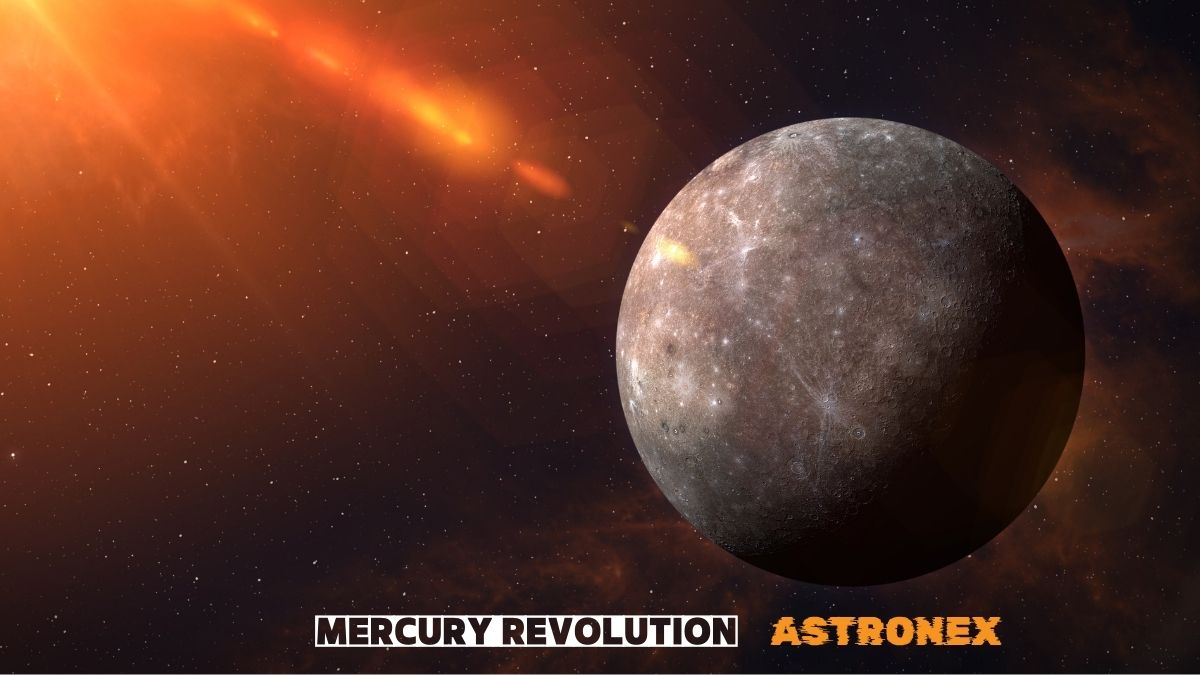
Mercury Revolution is the planet’s orbital motion around the Sun, and it defines the length of a Mercurian year. NASA states that Mercury completes one revolution in about 88 Earth days, the shortest orbital period of any planet.
Mercury’s rotation proceeds on a different timescale. The planet turns once on its axis in about 59 Earth days, yet the interval from one local noon to the next is far longer. NASA measurements show that one full cycle of daylight and darkness on the surface lasts about 176 Earth days, which is a little more than two Mercurian years.
These periods are not matters of convention. They are physical properties constrained by precise tracking of Mercury’s orbit and by repeated observations of how surface longitudes return to view under changing illumination. In planetary science, accurate values for revolution and rotation are required to predict when specific regions are sunlit and to interpret time varying surface observations.
NASA Mercury facts describe a highly eccentric orbit, meaning the planet’s distance from the Sun changes substantially during each year. The orbital path is an ellipse, and Mercury moves fastest when it is closest to the Sun. That variable speed is central to understanding how a Mercurian year relates to a Mercurian day, because the Sun’s apparent motion in Mercury’s sky depends on both the planet’s spin and its orbital progression.
A rotation period of about 59 Earth days means Mercury spins slowly relative to the pace of its revolution. The consequence can be expressed directly in the numbers NASA provides. Over the course of an 88 day year, Mercury completes about one and a half turns. Over two consecutive Mercury years, it completes about three turns. This repeating geometry is why the same broad regions can return to similar solar viewing angles at comparable points in Mercury’s orbit.
The distinction between rotation and a solar day is especially important at Mercury. A rotation period describes the planet turning once relative to distant space. A solar day describes the time it takes for the Sun to return to the same position in the local sky, such as from noon to noon at a fixed longitude. Because Mercury advances significantly along its orbit during each 59 day spin, the planet must rotate extra to bring the Sun back to the same local direction. NASA reports that the result is a solar day of about 176 Earth days. In this definition, a day is the time between successive noons rather than the time for one full spin. Mercury’s rapid revolution means the planet must rotate more than once before the Sun returns to the same local position. The long solar day is therefore an expected outcome of combining Mercury’s rotation with its orbital motion.
Mercury’s eccentric orbit also explains why the Sun does not always trace a simple, steady path across the Mercurian sky. Near its closest approach to the Sun, Mercury’s orbital motion is at its maximum. Under that condition, the planet’s orbital advance can briefly compete with the rate at which the surface rotates beneath the Sun. NASA notes that in some regions the morning Sun can rise, set, and rise again, and that a related reversal can occur near sunset elsewhere. This behaviour follows from changing orbital speed in an eccentric orbit. When Mercury is closest to the Sun, its orbital angular motion can temporarily match the rate at which the surface turns relative to the Sun. The Sun’s apparent motion can then slow, pause, and briefly reverse for observers at certain longitudes. As Mercury moves farther from the Sun and its orbital speed decreases, the Sun resumes its usual drift across the sky and continues toward the next long sunset.
The same framework clarifies what year length means in practical terms at Mercury. The year is the time needed to complete the Mercury Revolution, about 88 Earth days, which sets how often Mercury returns to the same position in its orbit and therefore the same overall distance from the Sun. The rotation period of about 59 Earth days describes how quickly a given longitude turns through space. The solar day of about 176 Earth days describes how long it takes sunlight to cycle through a complete local sequence of sunrise, midday, and sunset. In practical terms, the solar day is the interval that governs local illumination, and it is the timescale that links Mercury’s rotation to the experience of day and night.
Mercury Revolution therefore cannot be described by a year length alone. NASA measurements show a consistent set of periods, about 88 Earth days for one orbit, about 59 Earth days for one spin, and about 176 Earth days for one solar day. Together with Mercury’s eccentric orbit, these values account for the extended daylight cycle and the brief apparent reversals of the Sun’s motion at some locations.
References
National Aeronautics and Space Administration. (2025, April 25). Mercury facts. NASA Science. https://science.nasa.gov/mercury/facts/